Saturday, October 31, 2015

Exorcising Our Ghosts

Growing up I had my fair share of fears as I suspect most kids do.  In particular, I somehow learned to fear the dark and more particularly all the evil creatures that might be lurking under the bed, in my closet or just outside the window.  Every noise and small movement of shadow seem to be amplified, the precursor to my impending doom.  Several decades removed from those childish fears I still find myself somewhat anxious at the thought of a night out with my telescope observing the heavens.

The reality is, however, that in my youth those monsters were quite real.  And in truth it was only over time and not through any particular parental logic that there were overcome.  I profess to still having some fear of the dark but more often it is borne out of knowledge of what is really out there - farm dogs who might perceive me as a threat; skunks, coyotes or other wild animals; and other humans who might have less astronomical things on their minds.  My fears are more grounded in reality these days but yet they don't hold me back from pursuing one of my personal passions.  So what gets me out there in the middle of the night regardless of perceived or real ghosts?  In this case, it is the opportunity to gaze upon celestial wonders of far flung galaxies, nebulae and the rings of Saturn. In some bizarre and metaphorical sense I am driven to face my fears by a higher purpose.  Pun intended.

As an executive coach - and a leader/entrepreneur in my own right - I experience and realize that I can be subject to a number of different fears.  Most of these come down to self-doubt and the courage to take on new and different challenges in my career and business.  And I see similar behavior in many of the clients that I work with.  The mythical monsters that have lived in the closets or just outside our windows in our youth now stalk the halls and alleys of our hearts, souls and minds.  These monsters and ghosts are some of the most insidious we will ever face.  They know us well and play upon and magnify our weaknesses, insecurities, and doubts.  Left unfaced, they grow in strength and hold us paralyzed with fear striving to ensure that we never take that next step forward.

These ghosts just don't operate purely or even mostly on horror and shock value.  Rather, they are more cunning and possessed of a powerful voice, constantly talk us out of taking that next bold step into the future.  They are the voice that suggests that we really aren't qualified to apply for a new position.  They help us procrastinate and rationalize to the point where even if we were to apply and get an interview we would show up with the belief we didn't belong.  We display our anxiety to the point that those who would make the selection decision recognize our lack of confidence and make the non-selection decision we have been expecting all along.  We become our own self-fulfilling prophecy.

But like conquering our own childhood fears success in facing our more mature fears is possible.  My success and that of my coaching clients is proof of that.  In my first year away from an executive role and into my new venture I probably had more sleepless nights - and self-talk - than I'd had in the previous ten years.  What made this the right move?  Was my business plan just wishful thinking?  What made me think that my marketing efforts were the right ones? And so on and so forth.  I could say that it was a powerful vision of my ultimate success that kept me going but that would be too easy a way to rewrite history.  Truth be told, I was probably just too proud and stubborn to give in.  But I did ultimately face and conquer (most of) my fears.  I often did so with the encouragement, support, inspiration and examples of others.

In similar fashion I have been inspired by the courage that many of my coaching clients have ultimately demonstrated as they struggled with realizing their potential, seeking out new opportunities, and taking on new challenges.  We have helped them face their fears, challenge their self-limiting beliefs and powerfully own their strengths.  A quote from one of my coaching colleagues comes to mind in this regard - "Your mind is a dangerous neighborhood to go into alone."  So together, we have walked the dark halls and alleys of their mind, challenging assumptions, taking small steps, all in service of a grander vision of what is possible for them.  To realize their potential and open up new vistas that they had not even imagined.

The fears and doubt never truly go away.  I still fear the dark, I still fear swimming in open water, and I still fear that success enjoyed today is fleeting.  Even as my clients enjoy their current success (e.g., new job, award, raise, promotion) they still wonder how they will maintain or build upon that success.  Our fears and doubts won't go quietly into the night.  But perhaps rather than paralyzing us they can serve a more useful function of keeping us sharp and helping us prepare for potential (and reality-based) setbacks.

Keeping a higher purpose in front of us - the celestial heavens, the triathlon finish line, a successful and fulfilling career - is a foundation by which we can keep moving one step ahead developing our own level of reassurance that our fears are often overblown.  We can choose to live in fear or live in purpose.  We can look back on our past successes as harbingers of bigger things to come.  We can believe in our strengths an in our capacity to become stronger.  We can ultimately build the confidence and courage to overcome what is holding us back from our un-imagined potential.

Choose to face your ghosts, get off your (metaphorical bed), and shine a flashlight into the dark spaces.  What you don't find there might amaze you and lighten your load.

Exorcise your ghosts - own the night.


______________________________

Greg Hadubiak, MHSA, FACHE, CEC, PCC
TEC Canada Chair/Executive Coach/Senior Consultant
hadubiak@wmc.ca

Helping leaders realize their strengths and enabling organizations to achieve their potential through the application of my leadership experience and coaching skills. I act as a point of leverage for my clients. I AM their Force Multiplier.


Sunday, October 18, 2015

Resurrecting Deming

For some weeks now I've had the pleasure of teaching my first undergraduate course in leadership at Concordia University of Edmonton.  It's been a great experience and has allowed me to further develop and articulate my perspective on leadership. Just this past week it also allowed me to revisit the work of W. Edward Deming.  Over 22 years ago I studied his work as part of my master's thesis on total quality management.  

Perhaps too often the work of Deming and of other TQM, CQI, and quality guru's was viewed only through the lens of statistical process control.  More simply put leaders and managers limited the application, and impact, of TQM by implementing a set of tools.  These leaders missed out - consciously or unconsciously - on the changes that TQM required from a cultural and leadership perspective.  As I engaged my students this past couple of weeks on the topic of leading others the import of Deming's 14 Points on organizational culture and leadership effectiveness was reinforced as we reviewed the various bases of authority - legitimate position, coercion, reward, expertise and personal reference. 

Deming provided a leadership and organizational philosophy through his 14 Points that went far beyond a simple set of tools.  His first point - Create Constancy of Purpose - speaks to me about creating a long-term vision and adhering to a set of values that transcend short-term challenges or fads.  However, all too often leaders and managers fail to sustain a long-term direction whether because of a change in governing body, shareholder expectations, or other short-term considerations.  Whatever circumstance is used as the justification an organization and its staff are often left wondering what latest and greatest management initiative they are going to be tasked with making succeed.  Do this often enough and leadership credibility suffers and employee engagement declines.  A wait and see attitude prevails.  Sound familiar to anyone?

The next most relevant of Deming's 14 Points for me from a leadership point of view is End the Practice of Awarding Business on Price Alone.  How often do we do this either in the public sector as part of an RFP process or in the private sector as we grind down our suppliers?  From Deming's perspective a focus on up-front price alone fails to take into account long-term cost of a supplied product.  In colloquial terms you do in fact get what you pay for.  As a counter approach it is suggested that you build strong and sustainable relationship built on key values and common goals.  This approach can equally apply to suppliers and employees.  And maybe even competitors.

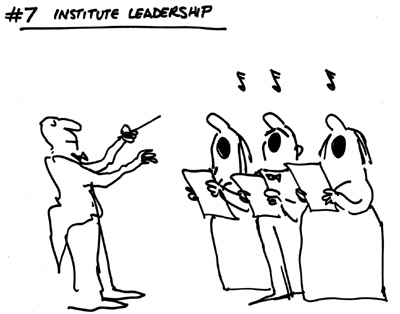
Institute Leadership.  Dr. Deming calls upon management to lead rather than manage.  Simple statement but what does it really mean for us as leaders?  Well I'm pretty confident that if you were to talk to many of our frontline staff and management personnel outside of the executive suite they would provide you with countless examples of where they felt they were being "managed", not "led".  A typical management response is to exercise greater control and oversight to make sure results get better.  More often than not in these circumstances efforts of this nature only seem to put more barriers in the way of getting good work done - more reports to generate, more signatures to get, more unreasonable timelines to meet, multiple and conflicting demands, and failure to hear and act upon input and recommendations from staff. 

Drive Out Fear in the workplace.  Unfortunately fear continues to rule too many of our workplaces.  The recent economic downturn has only exacerbated this reality and affirmed that for some staff remain as disposable - perhaps even more so - as any piece of machinery.  Fear - like title or position of authority - can be an effective tool of leadership and compliance in the short-term.  But over the long term, compliance does not equate to high performance.  With fear in an organization there cannot be open communication, innovation, and teamwork - and these are all required for an organization to achieve the full measure of its potential.  With fear in place an organization shall continue to squander the full potential of its people and the organization to the detriment of the people it purports to serve.

Eliminate Slogans, Exhortations and Targets for the Workforce.  Deming did not intend, nor do I suggest, that system performance not be evaluated on an ongoing basis.  Rather, what Point Ten addresses is the notion of trying to assess an individual's performance without reference to understanding the system in which that individual works.  If an individual is prevented from achieving higher levels of performance by a system (that management has created or allowed to be created) then performance managing an employee, setting new targets for them to achieve, and giving them "motivational" speeches will have little impact on performance.  It is far more likely that such efforts will actually cause frustration, demoralization and reduced performance.  It's like expecting employee engagement scores in an organization to go up simply by saying that the target is 10 out of 10 on the next survey.  Only by changing the system and the organizational environment will better, more consistent results be achieved. 

Remove Barriers to Pride of Workmanship.  In this point, Deming was referring to unclear expectations, lack of timely feedback (or any feedback), lack of training and support, and systems that focused on short-term results rather than long-term goals.  Staff and front-line managers are often frustrated by multiple tasks or changing priorities as leaders change focus or react to external stimuli without, it seems, due regard to long-term objectives or stated core values.  This negative impact is often compounded by the lack of visibility and sincere engagement with internal audiences on par with leadership visibility and engagement with external audiences.  Without the kind of internal alignment that I believe comes from such effort the ability to deliver on commitments to external audiences and customers stands on shaky ground.

Finally (at least within my view of leadership) Deming proposes that an organization Institute a Vigorous Program of Education and Self-Improvement.  In contrast, what does one typically see happen at the first sign of economic challenge in any organization?  Education and training programs are often the first cuts to be made.  When one considers the amount of transition that any organization faces in its environment today that seems tantamount to posting one's own going out of business sign. Businesses are unlikely to succeed by not investing in their most valuable assets - its people.  This can take the form of training in new tools and technology but these days can also equate to leadership development, management training and executive coaching.  Pay now or pay later.

There is a lot to be learned and relearned from Deming from a leadership perspective.  Despite the fact that his perspective was borne out of his work in the 1940s and 1950s there is still much relevance to leadership and organizational success today.  The fact that we still need to rediscover these lessons in so many of our organizations says much about our leadership maturity.
  ______________________________

Greg Hadubiak, MHSA, FACHE, CEC, PCC
TEC Canada Chair/Executive Coach/Senior Consultant
hadubiak@wmc.ca

Helping leaders realize their strengths and enabling organizations to achieve their potential through the application of my leadership experience and coaching skills. I act as a point of leverage for my clients. I AM their Force Multiplier.


Friday, October 2, 2015

THE Leadership Lesson from VW

Just a couple of weeks ago I was covering off the subject of business/leadership ethics in my foundations of leadership class at Concordia University of Edmonton.  In doing so I was referencing some very classic examples of ethical misdeeds (e.g., Enron) and examples more local to Alberta (e.g. health care expense claims, TransAlta electricity rates).   Unfortunately, just by scanning my local paper, I was able to come up with more than a few examples of recent misdeeds that could help illustrate the conflicted motives of leaders and organizational cultures that made headlines for all the wrong reasons.  In some cases, it was interesting to see some of the explanations and justifications for past or current actions.  One of the more interesting of these made note of the fact that the letter of the law had not been violated. Spirit of the law??

Unfortunately I was able to come back to my students with an even more recent and powerful example of violation of ethical - and legal - guidelines with dramatic consequences for key executives, a historically well-respected company, and millions of customers worldwide.  On September 23, 2015, one day after acknowledging that 11 million Volkswagen-made cars possessed software that duped official emissions tests, Volkswagen CEO Martin Winterkorn resigned from his post.  The consequences seem clear for Mr. Winterkron.  Loss of a respected and highly paid executive role.


The consequences for Volkswagen continue to evolve - investors punishing its stock (e.g., $15 billion hit on one day alone) to the chance that the U.S. government will levy billions of dollars in fines, to class action lawsuits (already filed in Canada).

In his statement of resignation, Winterkorn said "I am shocked by the events of the past few days," and "Above all, I am stunned that misconduct on such a scale was possible in the Volkswagen Group."  All that being said, he accepted responsibility for irregularities that were found and, like a warrior of old, fell on his proverbial sword.  He went further in expressing a perspective that "I am doing this in the interests of the company even though I am not aware of any wrong doing on my part." (italics my emphasis)

So let's assume that Mr. Winterkorn is forthright and truthful in his assertion that he was not culpable or aware of a manufacturing issues that allowed upwards of 11 million VW's to roll off its assembly lines that emit up to 40 times more pollution than allowed by US standards.  It's a hard assumption for me to swallow but lets go with that for now.

Presuming that this is all true I believe there is a much more challenging conclusion and leadership lesson that Mr. Winterkorn experience provides for all of us.  In the process of his admission he appears to acknowledge to me that either he had no influence or presence as CEO in establishing or sustaining the culture of VW or that by his leadership style and actions he helped to foster a culture that suggested it was quite acceptable to defraud customers, shareholders, the general public and government/ regulatory agencies in the service of the bottom line.  Either way not a very pretty picture of leadership.


Again presuming that Mr. Winterkorn was truly not aware of the massive fraud committed by VW under his watch, I tend to believe that more than just a failure of ethics this represents a unbelievably massive failure in leadership.  In my estimation, THE Leader is responsible for setting the tone for the quality of the organization's culture.  THE Leader defines the desired outcomes to be pursued, the balance to be maintained between competing objectives (e.g., profit versus environmental stewardship), and what the acceptable means by which these objectives are or not to be pursued.  What makes this example all the more egregious is the extent to which VW placed itself on a pedestal of its own making with claims of being environmentally friendly.

So aside from the legal and ethical implications that will get a lot more play by a variety of experts and pundits in the coming days and weeks, I challenge all of us to consider and consider again the impact you as a leader have on the culture and actions of all of your followers.  By your words and actions, even by what you don't do or say, you are setting the standards and expectations for your entire company.


At the end of the day if you are left to state that you "...are not aware of any wrong doing on my part..." as the epitaph on your leadership role it should be seen as a stunning admission that you weren't really leading at all.  And at the end, It's About Leadership.
_________________________________________________________

Greg Hadubiak, MHSA, FACHE, CEC, PCC
Director - WMC
TEC Canada Chair/Executive Coach/Senior Consultant
hadubiak@wmc.ca

Helping leaders realize their strengths and enabling organizations to achieve their potential through the application of my leadership experience and coaching skills. I act as a point of leverage for my clients. I AM their Force Multiplier.
 

Friday, September 25, 2015

Understanding Your Personal Leadership Capacity

This post comes courtesy of the intersection of a number of parallel but distinct events and experiences over the past week.  Often times as individual leaders and organizations we feel overwhelmed by the opportunities and challenges before us.  This reality hit me particularly hard - in more ways than one - this week.  I heard flavors of it from a couple of my coaching clients, in a strategic planning session I facilitated and from my own personal and business perspective.


From several of my coaching clients this week I heard the lament of too much on my plate, how do I get this all done, how do I prioritize and/or how do I get others to appreciate that my plate is already full.  If we flip the coin on this lament we can hear some other common themes that are all too often a part of our work these days - diminishing levels of employee engagement and challenges to work/life balance.  Sometimes these results are being borne out because of or in parallel to the perception or reality of lack of resources.  "If I only had more budget, more staff, more supplies...all this would be more manageable."  I suspect, however, that more resources is not the solution.  More resources may just mean higher expectations rather than management of existing workloads.  In some cases it might not matter how many resources were thrown at any one division or leader - the stress level might end up being exactly the same.

Just as challenging it would seem for some leaders or organizations is the willingness to say no or to otherwise prioritize the requests and workloads coming at them.  In some of these cases, as described by my clients, there appears to be an organizational willingness to say "yes" to everything that comes across the table.  Conversely, it may be that there is an organizational unwillingness to say "no" to anything that comes across the table.  This predicament is probably enhanced in the kind of economic downturn that my province is experiencing right now.  Saying no to a request might be perceived as tantamount to asking for your own termination notice.  Unfortunately, too many organizations have not been willing to truly establish the key guideposts by which they would evaluate any initiative that comes before them.  The result is predictable - yes is the answer to every initiative regardless of current workload or resources.  The long-term sustainability of such a response is hardly considered.  Just don't say no now.

Therefore, for me, it was refreshing to recently hear a CEO of a large organization espouse to his executive team and governing board the need to understand - and respect - their personal and organizational capacities.  Rather than demand more and more - as is the wont of many hard-driving executives - he was holding the feet of his people to a different fire.  Understand your capacity.  Understand that there are limits to the time available to you in a day, week, and month.  Understand that there are limits to your ability to handle multiple priorities.  Don't tell me you are going to add another initiative to your plate and keep to every other milestone you have already set.  Chose wisely and execute well.  It was a powerful message and one that clearly was being understood and accepted, even if slowly, over time.

The message of this forward-thinking CEO, an individual that I would no way characterize as soft, stands in sharp contrast to others I have experienced or worked with.  One of the most iconic examples is of a CEO who tried to alter his staff's perspective on prioritization by use of the somewhat infamous "Big Rocks in the Bucket First" exercise.  A decent enough exercise but it presumes that all managers and staff have the ability - or are allowed - to pick their own big rocks.  In the case of the forward-thinking CEO already noted this appeared to be the case (outside of regulated or legislated initiatives).  But for other CEO's, who most often define what the "big rocks" are, there is a lack of appreciation of how many big rocks can be rolled down the hill or the potential consequences of ignoring some of the "little rocks" that others in the organization need to work with.

In fact, perhaps it's time to update the Big Rocks exercise.  Perhaps there has to be an understanding of what size of bucket we are actually working with.  What's our actual capacity?  Perhaps as leaders we need to undertake a bit more of an internal environmental scan before launching the next big rock down the hill and understand how that fits with - or displaces - other rocks we have already launched yesterday or the week before.

The final hitting home point for me on capacity has come on my own business and personal side.  These past two months have been busier than at any other time in my current career and despite the economic downturn we are currently facing.  That fact alone has already challenged my "capacity" and more particularly made me feel that I have been less of the quality family man then I should be ans aspire to be.   Others - most notably my wife - has taken up more of my personal "overflow" than is acceptable.  While potentially manageable in the short-term the stress tolerances of continually exceeding one's capacity has inevitable and predictable consequences.


The lesson of capacity is one that I'm trying to learn (or learn again) in my personal and business life and I trust that you can be more forward-thinking, insightful and discerning as you contemplate launching your next big rock into your leadership or organizational bucket.
_________________________________________________________

Greg Hadubiak, MHSA, FACHE, CEC, PCC
Director - WMC
TEC Canada Chair/Executive Coach/Senior Consultant
hadubiak@wmc.ca

Helping leaders realize their strengths and enabling organizations to achieve their potential through the application of my leadership experience and coaching skills. I act as a point of leverage for my clients. I AM their Force Multiplier.

Tuesday, September 15, 2015

What's Your PCR Level?

Leadership is about change.  Leadership is about seeing what must be done, oftentimes more uniquely than anyone else around you including your competitors.  It's also about understanding how you can effectively, efficiently and profitably implement change, appreciating how all of the various market and internal forces of your company may support or challenge your change effort.  And finally, after appreciating what the environment and opportunity might be, there is the necessity and the courage required to take action.  Without combining action with insight and vision one may be merely in possession of a beautiful but unrealized dream.

Effective leadership, however, doesn't start by scanning the external environment for threats and opportunities, nor by looking at the skills, abilities and capacities of one's company or staff.  In my estimation, effective leadership comes from the ability to critically evaluate one's own leadership skills and gaps.  Moreover, once that assessment is made there is a requirement to act on the opportunities presented.  In this regard I then ask you what's your PCR Level - what is your Personal Readiness for Change?

By any measure, regardless of sector we are working in, we see and believe ourselves to be in change overload mode.  Nothing stays the same for long.  Science fiction technologies we dreamed of only yesterday are today's reality.  For me one of the best examples is the ongoing drive (no pun intended) to realize driver-less technology - taking the human factor out of the automobile.  If you are like me perhaps your first thought is what impact could this have on the transportation sector.  But if we think bigger what might realization of this science fiction dream mean for the insurance industry (e.g., are they still going to be in the business of insuring individual drivers), education (e.g., will there be anything like driver's education and licensing?), and entertainment (e.g., I guess I don't have to worry about getting my next distracted driving ticket anymore...).  What does this kind of rapid and disruptive change mean for where you are working now and what kind of leader you will need to be?

If we go back to a core definition of what makes a leader - seeing what needs to be done, understanding how it could be done, and having the courage to act - how will you effect continuous evolution (or revolution) in your leadership?  I don't really believe that there is any question of whether you should or should not invest in your continuous evolution as a leader.  Perhaps the only leaders who might consider themselves immune from this requirement are those who are only a few years (or months) away from retirement and those that have become independently wealthy.

So how do you see what needs to be done for your leadership evolution?  Do you periodically and objectively evaluate your leadership acumen through a skillfully applied and interpreted set of assessment instruments (e.g., EQi, SDI, etc.), do you seek out broad-based feedback from key stakeholders (e.g., Board of Directors, peers, subordinates), or do you open yourself for "review" by a peer advisory forum (e.g., TEC Canada) on an annual or more frequent basis.  Ideally, you are not just relying on your own level of self-awareness to achieve insight to target next steps in your leadership evolution and development.  We all have blinders on - for good or bad - and we all require other perspectives to truly come to conclusion and really see ourselves as we are, warts and all.

Second, do then investigate and appreciate the "how" of dealing with the "what" you have seen for yourself?  Too many leaders suggest or kid themselves into believing that they simply don't have time for ongoing self development.  They are far too important to be absent for any length of time from their place of business.  They are irreplaceable.  The fact is that if you believe any part of the reality of being the most important tool you have to ensure the success of your business venture then you are too important to not devote time to your leadership development and evolution.  EVERY tool must be sharpened periodically to continue to be effective.  To be of any use to your business you had better be the sharpest tool in the toolbox.

Finally, both in terms of seeing what must be done for yourself and how it may come to pass, you must have the courage to act.  This means having the humility to see your leadership for the quality it is and is not.  It also means having the courage and humility to recognize that some of your skills may be outmoded and need of upgrading or wholesale replacement.  The key word here is humility. I've worked with too many leaders who failed to appreciate - or actively resisted/dismissed - the feedback they were receiving.  Alternatively, despite having received and accepted the feedback, they felt they could not afford the time or money to invest in their leadership development.  Either way they ended up doing a disservice to themselves, failing to reach their true potential and effectively held back the performance of their staff and their company.

So what's your PCR Level?  Are you willing to see yourself objectively, are you prepared to truly evaluate your options for improvement, and are you prepared to act with humility and courage to take your leadership to the next level required by the changes happening around you.  It's not science fiction.  It's About Leadership.

_________________________________________________________

Greg Hadubiak, MHSA, FACHE, CEC, PCC
Director - WMC
TEC Canada Chair/Executive Coach/Senior Consultant
hadubiak@wmc.ca

Helping leaders realize their strengths and enabling organizations to achieve their potential through the application of my leadership experience and coaching skills. I act as a point of leverage for my clients. I AM their Force Multiplier.


Monday, September 7, 2015

When NOT to use Executive Coaching

I'm a strong advocate for the use of executive coaching.  As an executive coach myself you'd probably expect nothing else.  However, I'm not just speaking as someone who provides executive coaching services but also as someone who has benefited from and continues to benefit from using an executive coach.  I've experienced first hand the power of having an unbiased sounding board and accountability partner work with me to perform at the next level or work through particularly challenging times.

However, while executive coaching can be one of the most effective ways of accelerating your development as a leader its not the panacea for all situations or circumstances.  There are in fact times when an individual and an organization should consider other options for addressing leadership or organizational challenges.  I identify some of these circumstances - where executive coaching may not be your first choice - below.
  1. Executive Coaching in lieu of performance management.  Good executive coaching should not be substituted for good - or bad - management.  I've had a few occasions where I've been approached to undertake a coaching engagement where it's clear that a leader's perspective or that of an organization is that executive coaching is the last ditch effort to "salvage" an employee.  At this stage, its often relatively clear that the employee in question is on their last chance but unfortunately have gotten to this point because of poor hiring process at the beginning of their tenure, poor expectation setting and communication on the part of their direct superior, or a combination of related factors.  Ideally, executive coaching is more often applied to advancing an organization's high potentials rather than salvaging those an organization no longer has any faith in.  More often than not in these cases I would prefer to coach both the employee offered the opportunity as well as their direct superior.
  2. Lack of defined outcomes or objectives.   Any good executive coach and any strong organization will seek to establish an understanding of specific goals and objectives for the engagement.  Whether sought out by an individual or secured through organizational endeavor, the quality of an coaching engagement is measurably improved when all parties involved are on the same page when it comes to understanding what success is supposed to look like.  If there are no clear outcomes established - whether at the outset or relatively early in the engagement - then there is a risk of "any destination will do" coming into play.  As with any initiative, being able to define and measure success is key to achieving such.  
  3. Client is unprepared to work.  An executive coach is there to challenge your thinking and assumptions, to move you to new levels of performance, and to enhance confidence through action.  But just as it is incumbent upon you (sometimes in partnership with your organization) to define the outcomes it is equally essential that you show up in the coaching session ready to work.  The time spent with a coach should not be akin to pulling teeth - you are addressing your current challenges, taking charge of your future, and you should be prepared to work as hard - and harder - than your coach.  You should not expect your coach to offer up ready-made solutions.  A coach is there to help you discover and execute on your own self-discovered plan of attack.  If you expect your coach to do the heavy lifting for you you are probably not ready for, nor will you fully benefit, from working with an executive coach. 
  4. Client is unprepared to work - Part II.  The work in a coaching engagement doesn't just or even mostly happen when you are face-to-face with your executive coach.  Your time with your executive coach is designed to develop plans, explore options, test assumptions and commit to change.  While a change in perspective and perception will happen in the executive coaching session, delivery and action happens in between sessions and back at the coal face of your work.  All the best laid plans are only as effective what actually happens when you implement your plans.  If you have no interest in implementing your plans or making time for change in your work its best not to engage an executive coach.  
  5. Unprepared to Change.  If you are thinking about engaging an executive coach, be prepared to change.  Growth comes only from change.  Change is often or entirely uncomfortable.  If you are only looking for validation or affirmation there are likely other avenues for you to pursue.  Engaging with an executive coach is not about maintenance or just having a great conversation.  You - or your organization - is expecting you to evolve, grow and change as a result of the investment of time and money made in an executive coach.  Work with an executive coach is not about maintenance of status quo.  You should expect that when you choose an executive coach that you will be undertaking new challenges, overcoming anxieties, and assertively progressing forward.  The coaching engagement should make you feel uncomfortable.  Be prepared for and embrace change!
  6. Unprepared to drive the agenda.  Sometimes it's of benefit to think of your executive coach as your co-pilot.  You are in charge of where you need to go.  You define the work for each session.  Again your executive coach will be there as a guide, a thinking partner, and a challenger, but you are in charge.  You are the leader in your business (and personal life) so be the leader in your own personal development.  Work with your co-pilot to plot the course at each session and once decided focus on your path.
  7. Unprepared to be truthful, candid and honest.  Your executive coach is focused on your success.  Period.  In that regard, if you have done the best job possible in selecting your executive coach you've determined a fit does in fact exist, you trust the person in front of you and you are confident in their track record in support of your goals.  So don't beat around the bush.  Time is money and if you are going to move forward assertively be prepared to be vulnerable.  It's in your best interests and your executive coach has no other agenda than what works for you.
  8. Unprepared to own the coaching relationship.  As tough as it might be for some executive coaches, you are the customer and the customer is always right.  Tell your coach - your vendor - what is working for you in the coaching engagement, what's not working and how the work can be changed to be more effective.  If you are not prepared to do that you may be disappointed in the results you get - or don't get. 
Coaching can be a powerful tool in moving leadership forward in a powerful way but much of that success depends on using it in the right circumstances, for the right reasons, and with ownership of the effort on your behalf and that of your organization. 

 _________________________________________________________

Greg Hadubiak, MHSA, FACHE, CEC, PCC
Executive Coach/Senior Consultant
gregh@breakpoint.solutions
780-250-2543

Helping leaders realize their strengths and enabling organizations to achieve their potential through the application of my leadership experience and coaching skills. I act as a point of leverage for my clients. I AM their Force Multiplier.

Sunday, August 30, 2015

Your Personal Leadership Walk Around

In fits and starts I've been trying to rediscover my Ironman triathlon form of several years ago.  Most recently, as I hopped back on my bike and wind trainer, I really had a strong sense of how far I might have fallen from peak form.  I was really laboring on this early return to the bike.  I felt like my legs just weren't firing and my underutilized lung capacity wasn't helping either.  It was a frustrating start to a hoped for workout.  I had assumed that my efforts and changes in physical condition over the past number of years would have at least allowed me to start off at a relatively modest pace and not feel like things would be a complete do-over.

Somewhat gratefully, however, I did discover that my issues were not all physical.  Since 2010 two other children have been added to our family and I had failed to take into account the havoc their curiosity might play in my return to physical fitness.  As I looked down at my controls, it became evident that small hands had doubled the tension I had been traditionally used to on my workouts.  Problem identified and problem solved, right?  Not quite.  After having made the change and assuming that I was good to go I still seemed to struggle.  What I discovered, after a now shortened ride, was that these same small hands had pulled on the cable leading to the wind trainer such that whatever adjustments I made from my seated position had absolutely no effect on the effort I was forced myself to exert on my training ride.  Lesson learned - check all equipment before starting one's workout or suffer the consequences.

I'm hoping you start to get the drift of this somewhat belabored athletic metaphor for how we approach our leadership on a daily basis.  How many of us assume things about our leadership, our teams and our organizations every day?  How many of us are surprised by the results we get or don't get as a result of assuming that all of the right things will happen without some sort of conscious, regular and disciplined examination of our environment, our tools, or our approach.  Perhaps like me on my bike, your initial reaction has been disappointment with lack of performance.  Maybe you've even gone a bit further - as I have on occasion - and expressed your disappointment in more cutting, vitriolic and colorful terms.  This more challenging response may be directed at yourself (e.g., "Come on, you can do better than this!") or at others (e.g., "How could you let this happen?").  In either case we may be assigning blame to the wrong cause or to the wrong people.

The fact is that we can all benefit from our own personal leadership walk around on a regular if not daily basis.  I've shared a simple analogy from my workout process.  All who do any kind of serious racing will attest to the necessity of checking out equipment, hydration, nutrition, and mental state the night before and immediately prior to any race.  Not doing so leaves you open to nasty surprises and puts you in serious jeopardy of missing out on your personal goal. Why would you not do a similar check-in each day with yourself as a leader when what is at stake is not just your own personal performance or goals but also the welfare, well-being and success of your team and your organization?

So what might a personal leadership walk around look like?  And as with any team, are you allowing others to help you with your personal leadership walk around?  Do you have the humility to ask for and accept advice on how you leadership could be improved?  Even CEO's, Presidents and Owners need some form of input.  Do you foster an environment in which it's safe to bring attention to your blind spots?  Do you have mentors, peers, colleagues or coaches that can bring some light to your challenges and assumptions.

What does your personal leadership walk around look like?  Or are you content to work harder than you might have to with less than optimal results by just doing things yourself, making erroneous assumptions, and becoming frustrated with yourself and others.  I encourage you to take a step back every once in a while and see if your "tension" is on a higher setting than you desire.  It's About Your Leadership after all.
 _________________________________________________________

Greg Hadubiak, MHSA, FACHE, CEC, PCC
TEC Canada Chair/Executive Coach/Senior Consultant
hadubiak@wmc.ca

Helping leaders realize their strengths and enabling organizations to achieve their potential through the application of my leadership experience and coaching skills. I act as a point of leverage for my clients. I AM their Force Multiplier.


Friday, August 14, 2015

Practice Makes Perfect?

Practice makes perfect.  I trust that most of us have heard of that phrase and in many cases have used the underlying intent to drive their personal and business lives.  Repetition is a fundamental key to learning and to developing excellent skill in any area of endeavor.  This perspective may have been given even more popular weight by best-selling author Malcolm Gladwell.  Based on his research and expounded upon in his book Outliers, Gladwell suggested the notion that 10,000 hours of appropriately guided practice was the magic number of greatness.  More provocatively he also suggested that this level of greatness could be achieved regardless of a person's natural aptitude.  Based on that premise or theory, I have to assume with 10,000 hours of appropriately guided practice I could become a world-class violinist.

I'm not sure anyone, including myself, could tolerate 10,000 hours of me practicing the violin.

I find some corollary to Gladwell's theory in the work of Jim Collins in his book Good to Great.  More specifically he talks about the discipline it takes to become a great company and, I would suggest, a great leader.  The underpinning of his model is Disciplined People engaged in Disciplined Thought taking Disciplined Action.  Much like Gladwell, Collins believes that discipline is not enough.  Rather there has to be an "appropriate" type of discipline in play to ensure progress or success.  In Collins' words, "Everyone would like to be the best, but most organizations [or leaders] lack the discipline to figure out with egoless clarity what they can be the best at and the will to do whatever it takes to turn that potential into reality."  (bold is my emphasis)

So while Gladwell and Collins both might agree that practice and discipline are critical to success they qualify their statements with words like appropriate, egoless, clarity, and guided.  This brings me to my assertion, akin to something you may have also heard before, that practice in and of itself does not make perfect, rather only perfect practice makes perfect.  Unfortunately too many of us - leaders included - become creatures of pattern and of habit.  What we learn early on in our careers we tend to perpetuate as we move up the chain of command heedless of changes in our personal or business environment.  A simple analogy to this effect is our ingrained patterns of travel to and from work.  How many of us have found ourselves having arrived at work and possessing limited conscious memory of the drive there?  How many of us, upon changing workplaces, find ourselves still habitually driving to our old place of work?

I'm not saying practice or discipline are bad or wrong.  Rather, as leaders we need to ensure that practice and discipline are a function of conscious thought and intent.  As leaders we need to set aside and demand of ourselves time to reflect on what practice might get us perfect or better results.  As leaders we need to set aside and demand of ourselves the discipline to exam with courage our assumptions, beliefs, and even values in pursuit of leadership and organizational excellence.  If in fact a leader is required to achieve different or better results simply practicing more or being more disciplined at the same tasks and expecting different results equates to a popularized definition of insanity.

So what will it take to identify perfect practice and correct discipline for leadership success?  As trite as it might sound, leaders need to structure time in their busy schedules to step back and consciously reflect on their work and the work of their company every day.  This means shutting down your e-mail, turning off the smart phone and locking your door.  And if you have enough courage, strength and discipline do this twice a day - at the start and end of your day.  At the beginning of your day reflect on what your unique deliverables are as a leader.  What alone do you need to take responsibility for?  What do you alone need to achieve to feel accomplished and to have delivered value?  At the end of your day, reflect on whether you moved the needle towards the accomplishment of your unique deliverables.  Did you fulfill your personal responsibilities as a leader?  Did you accomplish what you expected of yourself?  Did you deliver on your unique leadership value proposition?  What's your plan for tomorrow?

Too many of us may balk at the notion of taking time out of our busy day to engage in individual reflective contemplation.  We may believe that taking 30 minutes out of our day for such navel gazing is nothing short of insanity itself and certainly a waste of time when so many urgent issues call for our attention.  My view is that unless you have the discipline to engage in the practice of reflective thought and evaluation your leadership may amount to nothing more than then a frenzied expenditure of your valuable energy and intellect.


If you can't manage your leadership energy, if you can't consciously evaluate your practices and demonstrate discipline in thought, how do you realistically believe you are really leading others effectively.  It's about conscious practice and conscious discipline and it's about leadership.  It's about your leadership.

 _________________________________________________________

Greg Hadubiak, MHSA, FACHE, CEC, PCC
TEC Canada Chair/Executive Coach/Senior Consultant
hadubiak@wmc.ca

Helping leaders realize their strengths and enabling organizations to achieve their potential through the application of my leadership experience and coaching skills. I act as a point of leverage for my clients. I AM their Force Multiplier.


Tuesday, August 4, 2015

Power...and the Aura of Power - Redux

About a year ago I provide some commentary on revelations on the alleged transgressions of Premier Alison Redford.  At that time the phrase of the moment was "Aura of Power" and I suggested that such transgressions are rarely if ever undertaken or achieved alone.  Last week I was provided with a reminder of the capriciousness of power and perhaps more to the point that power corrupts and absolute power corrupts absolutely.  The event in question was learning of the summary dismissal of a long-standing executive in a firm that I have come to know over the past couple of decades.  I had no particular emotional response to the news, because - as I've become accustomed to saying in the leadership game - I'm never surprised anymore, just disappointed. 

In reality, I wasn't surprised by the termination.  Rather it served to reinforce what I believe I have seen in relation to an ongoing diminishment of the values that I thought animated this particular organization.  Perhaps even more disappointing is my perspective that an organization that I believe once held so much potential to really help change things for the better in its sector seemingly has been sacrificed to other goals and agendas. 

My perspective might rightly be accused of being too driven by naivety and idealism.  Power and organizational politics are certainly a dirty game and perhaps I operate under too many illusions about the (altruistic?) motives of those who aspire to lead our modern day organizations.  As many of my clients might ask me "Is it any better anywhere else?" and I keep answering "Yes" but maybe that opinion is driven more by hope than by practical reality.  Perhaps too, that perspective is given energy by the fact that so many people are asking the question, are seeking out and yearning for better leadership, and may be in fact the future leaders that they and I are looking for now.

I wish that this might be the end of the story but I'm not convinced of that.  As I contemplate a change in approach or climate I'm realistic enough to know that change in leadership approach or tactics only comes about for compelling reasons.  If there is no "blowback" to change up a so-far-successful approach why change?  On the contrary, if success is defined by solidification of leadership position and the trappings of power all is well.  If it ain't broke don't fix it I assume.

The reality of leaders who abuse their power - even at the risk of public exposure or worse - continues to exist primarily because some leaders do feel entitled, all powerful and above reproach.  In some cases they may even believe that they are doing nothing wrong, that anything that benefits them somehow benefits all, and even if there are abuses they will never be discovered.  They operate with immeasurable confidence in their own superiority and are not reluctant to use fear and intimidation as weapons to build, sustain and grow their personal position.

I have no words of advice or perspective to offer those who would abuse their power.  They would probably give little or no credence to my thoughts or opinions in any event.  Rather I focus my admonitions to those OTHERS that allow and facilitate this type of leadership.  Leaders, regardless of their personal capacity and capability, do not achieve their ends - or alleged transgressions - on their own.  And make no mistake, this kind of leadership behavior is not isolated to any one sector.  Leaders in the private and public sector - both good and bad - work with and through others.  Salaries ultimately have to be approved by someone, terminations have to be processed through a human resources and legal infrastructure, expenses are signed off somewhere in the financial chain of command, and any bending of rules and regulations have to be overlooked or managed by more than the person directly benefiting.  Some of us tie ourselves in proverbial knots trying to manage the ethical scenarios we find ourselves placed in.   Many of us might try to find some solace or comfort to say that WE were intimidated by our leader, that we feared for our jobs or careers, or that "we were just following orders".  Some of us may even  have developed a misplaced sense of loyalty to the leader, becoming confused in believing that what is good for the leader might be or should be similarly good for the organization.  

Worse is that we may have been co-opted by a flawed or narcissistic leader.  For those serving a narcissistic leader they may see their future tied to this powerful, but flawed, boss.   Maybe they hope to gain a new or more prominent position in the short-term.  Others see loyalty as key to their leadership aspirations down the road.  And sometimes they believe that it is best to protect their leader for the sake of their organization's standing and reputation.  Our job satisfaction, salary, bonuses, enhanced benefits, and other perks can be used to build a sense of commitment to a flawed path.  WE are a multimillion or multibillion dollar organization.  There is great pressure and responsibility that comes with being a leader so some might even justify their actions as some "small" recompense for these leadership sacrifices. What's wrong with a few extra hundred, thousand - or hundreds of thousands - dollars coming my way?  What's wrong with bending a few rules here and there? 

This doesn't happen overnight.  Rather it very much mirrors the iconic story of a frog slowly being boiled to death.  Slowly but surely we compromise our values and high ideals because no one step or decision seems critical or egregious enough to cause us to stand up for what we say we believe in.  One day we just wake up and know that we are well past the line we vowed never to cross - or maybe we now find ourselves having to deal with uncomfortable stories on the front page of our local newspapers.  Whether as governing boards, as peers, or colleagues there are ample opportunities for us to exercise oversight, fulfill assigned duties, ask questions, or find the courage to say no.  Unfortunately, sometimes the biggest surprise comes when despite having made all these slow and steady compromises with our own personal code of ethics we still wake up wondering what happened when we too have outlived our usefulness to the goals and power of the leader above us and find ourselves outside looking in.

It is my belief that WE often don't lack for proper policies, procedures, processes and protocols to hold ourselves to high ethical, professional and organizational standards.  More often WE lack the courage to use those tools and to hold to our values.  More often WE are not prepared to pay the price or endure the pain that comes from exercising that courage.

Some time ago I finished reading a biography of Dietrich Bonhoeffer (author - Eric Metaxas).  It details the life of this German pastor, theologian, and author with a particular focus on his struggle against Hitler and Nazi Germany.  This is not a simple tale of right and wrong as it could easily have been turned into.  Bonhoeffer's struggles in finding his path are well documented by the author.  In the words of Bonhoeffer himself he struggled to determine what was "right" versus what was the correct and loyal behavior for a German leading up to and through World War II.  He often fought with and was reviled by his peers.  He progressively lost his ability to practice as a pastor, to teach and to write.  Regardless he held true to his values and exercised choice in how he would live and lead.  His choice to not compromise his beliefs as to what was right for Germany and the Christian community ultimately resulted in his execution just days before the end of World War II.

I'm not suggesting WE have to die for what we believe in.  What I am suggesting is that WE have far less at stake in holding ourselves and our leaders to account than someone like a Bonhoeffer, that WE have far more choice to do so than WE would like to believe, and WE have opportunity - and examples to guide us - in finding the courage to enforce a standard of leadership that WE deserve.

Be clear on your values, exercise your leadership, and make a difference because of it.
  ______________________________

Greg Hadubiak, MHSA, FACHE, CEC, PCC
TEC Canada Chair/Executive Coach/Senior Consultant
hadubiak@wmc.ca

Helping leaders realize their strengths and enabling organizations to achieve their potential through the application of my leadership experience and coaching skills. I act as a point of leverage for my clients. I AM their Force Multiplier.

Monday, July 27, 2015

Handyman or Expert?

A number of years ago I undertook a rather massive home improvement project with the help of some friends.  The project in question was construction of a nearly 500 square foot stone patio in my back yard.  I enlisted the help of some friends, some of whom had some experience in similar projects. The factors that I weighed in the decision came down to cost and perceived complexity (e.g., puffing out our chests and declaring our manliness we said "We Can Do It!").  There was also going to be the satisfaction of a project that I could physically and mentally participate in and achieve.

Things turned out well enough at the time, I learned a lot - most of it the hard way - had some relatively cheap manual labor at my disposal for a weekend, and impressed my girlfriend at the time with my physical stamina in shoveling load after load of crush and sand, placing stone after stone, and finishing a large project in relatively short time.

Several years later, however, I find that I've had constant repair work to do on my masterpiece, dealing with some subsidence in key areas of the stone patio and now worrying about at least one retaining wall needing an extensive redo.  Perhaps the "cheap and cheerful" way associated with my amateur handyman approach several years ago isn't leaving me with quite the legacy I hoped for??  Maybe an "expert" would have been better engaged despite the up-front cost??

So how does this story relate to leadership?  Too often I see some of the same mentality coming into play during evaluation of personal or organizational coaching, leadership development or consulting requirements.  Cost definitely comes into play as it should.  But rather than evaluating such expenses as an investment and weighing such against the hard outcomes desired there is a decided emphasis on cost-control.  A "good-enough" mentality enters the equation and a desire to either do-it-ourselves or hire a "handyman" for truly foundational work.  So can you do it yourself or hire on a non-certified coach or consultant to support your efforts?  Sure, but you might wonder if the investment of time and effort really gave you the return you required or ended up being sustained beyond your initial intense effort.  Like my home improvements, you might have been better to engage an expert at the beginning rather than engaging in constant "repairs" or investments to achieve the product or results you hoped for in the beginning.

I'm suggesting there is a leadership lesson to be learned from my home handyman approach noted above.  Leaving aside the do-it-yourself effort for now - which requires a great deal of personal or in-house skill that most don't have - how do you discern the "handyman" from the professional support you might need in coaching or consulting?  Solid track record and referral base are clearly good indications but I'm also going to recommend that you look for impeccable credentials including certification in national or international regulatory bodies.  Holding or pursuing such a credential (e.g., International Coach Federation, Canadian Association of Management Consultants) is a sign that the individual professional not only demonstrates knowledge and skill in their chosen field, but also holds themselves to the highest professional standards and are prepared to be judged according to a strong code of professional ethics.

Further, certified members of these professional associations have chosen to contribute to a broader body of knowledge, to regulate themselves and provide accountability to clients and their profession as a whole. Credential-holders complete rigorous education and practice requirements, providing testimony to their commitment to excellence.  These professionals look to protect and serve consumers of their services, measure and certify competence of their members, and inspire the pursuit of continuous development.

At the end of the day the choice of how to deal with your coaching, leadership or consulting requirements is fully in your court.  Credentials are certainly not a 100% guarantee of success but just like in home renovations they are a better bet than just looking for the cheapest bidder. As in my do-it-yourself reno, you can pay now or pay later (or both).  Make the time and investment pay off.  In this case, It's About Leadership!  And there is nothing more worthy of your investment than that which leverages all of the rest of your success - your leadership assets.
______________________________

Greg Hadubiak, MHSA, FACHE, CEC, PCC
TEC Canada Chair/Executive Coach/Senior Consultant
hadubiak@wmc.ca

Helping leaders realize their strengths and enabling organizations to achieve their potential through the application of my leadership experience and coaching skills. I act as a point of leverage for my clients. I AM their Force Multiplier.


Wednesday, July 22, 2015

Great Leaders

What makes a great leader?  These days, with the ubiquitous nature of social media, there is no shortage of published opinion, top ten lists and assorted other commentary on what makes a great leader.  The challenge seems less in knowing what great leadership should be than in actually finding sentinel examples of such in real life!  Without a doubt we have individual leaders who command great power and reap great rewards in all sectors of society.  But as I pen this note I'm reminded of an exchange between two characters from the 1995 movie "The American President" which for me encapsulates the challenges we face in seeing leaders for what they are or are not:


People want leadership, Mr. President, and in the absence of genuine leadership, they'll listen to anyone who steps up to the microphone. They want leadership. They're so thirsty for it they'll crawl through the desert toward a mirage, and when they discover there's no water, they'll drink the sand. 

Lewis, we've had presidents who were beloved, who couldn't find a coherent sentence with two hands and a flashlight. People don't drink the sand because they're thirsty. They drink the sand because they don't know the difference. 

A damning statement on "our" collective ability to evaluate and select the quality of leaders we need!  Even more so when we consider how much more complex and challenging our organizational environments are becoming. It seems to me that this fictional representation and discourse on leadership is highly reflective of the issues we face in assessing and evaluating leaders in a variety of circumstances.  In my home province we recently made a political choice between three very different leadership personalities and visions.  Time will tell whether we have assessed and chosen correctly.  This fall, Canada will likewise have the opportunity to select its Prime Minister to govern us for the next number of years.  Likewise the United States gears up to choose its next President and may have the opportunity to choose between Donald Trump and Hilary Clinton.  So on what basis do make these momentous decisions?  My hope is that in all cases - political or otherwise - we choose less out of historical reflex, anecdote and emotion and more out of thoughtful consideration of what makes a great leader.

As you may have already ascertained from past blog posts, I operate from a certain perspective on what makes a great leader.  I offer you this short list of factors to explicitly identify what I believe are important considerations on leadership choices.  These build upon my own personal experiences of great - and not so great - leaders.

One -Visionary.  This may seem completely self-evident but I daresay there are a number of leaders in positions of substantial power that have a less than well-developed vision to guide them and their followers.  Vision for me has a very specific connotation.  It is a perspective or destination that extends beyond anyone political term or short-term horizon.  It is also clearly resonates and motivates others to action and is not simply about profit and loss, stock options, dividends or executive bonuses.

Two - Authentic.  Great leaders and strong leaders are authentic.  There is no mask or pretense about them.  They don't pretend to be who they are not.  They recognize and own their strengths and their weaknesses.  Too many leaders try to present as the perfect specimen of leader, without flaw and without doubt.  To my mind this simply reinforces a perception of their own insecurity and prevents them from truly connecting with their followers.

Three - Focus.  Hand-in-hand with being visionary, great leaders ensure that they and their followers focus on work that matters to achievement of the vision.  They don't allow themselves to be distracted and similarly help followers stay focused on critical elements of work and success.  Great leaders continue to stoke passion and hope in achievement of vision despite challenges and inevitable setbacks.

Four - Stay True.  Perhaps similar to focus, but great leaders aren't afraid to chart their own course, to take the path less traveled.  They distinguish themselves from the pack and similarly help their organization distinguish themselves in their marketplace.  Great leaders seek out new markets, new methods and new ways of thinking and acting to build success.

Five - Risk Taker.  Success and greatness often requires risk.  If there is no risk there is no reward.  Each of us has our own definition of and means of assessing risk.  Great leaders may sometimes be perceived as taking foolish risks but in many cases they just have a different mental mindset about what constitutes acceptable risk.  They also appreciate that "playing it safe" also carries it own risk not the least of which is being left behind and becoming irrelevant.

Six - Inner Strength.  Great leaders recognize that not everything goes as planned or as desired.  But they are resilient in the face of such challenges.  Moreover, they don't look to assign blame to others or extraneous variables.  They assess, analyze and find a new path forward, learning from failure, continuing to move forward to on their personal and organizational vision.

Seven - Build Relationships.  Great leaders recognize that leadership is not a solo endeavor.  By its very definition leadership requires that there be followers.  Effective relationships are built on a foundation of trust, respect, belief in and commitment to a common vision, authenticity and integrity of word and action.  Without relationships leadership cannot, by my definition, be great.

So as you assess your own leadership ambitions or are in position to evaluate the leadership aspirations of others, I encourage you to critically evaluate yourself or other candidates against these criteria or those of your own choosing.

The most important request is that you indeed critically evaluate before choosing.  It's About Leadership!  It's About Great Leadership! 
______________________________

Greg Hadubiak, MHSA, FACHE, CEC, PCC
TEC Canada Chair/Executive Coach/Senior Consultant
hadubiak@wmc.ca

Helping leaders realize their strengths and enabling organizations to achieve their potential through the application of my leadership experience and coaching skills. I act as a point of leverage for my clients. I AM their Force Multiplier.