Wednesday, September 18, 2013

Constancy of Purpose

One of the first blog entries I penned over a year ago focused on the work of Dr. W. E. Deming - one of the key figures in the foundation of total quality improvement.  In that entry I focused on only a few aspects of his work and his famous fourteen points.  What was clear then and is still evident today is that his work still holds truth for us in today's business environment even though he expounded his framework over 60 years ago. 

Last week, while I was in San Diego with other TEC Canada/Vistage chairs I learned of yet another round of personnel and organizational changes in Alberta's health care system.  At this point I've lost track of how many changes this makes for the health care system since the creation of Alberta Health Services in 2008, much less the changes since the mid-1990's.  This latest change had me reflecting on Dr. Deming's first point in his fourteen points - "Create constancy of purpose for the improvement of product and service."  What Deming was responding to and was trying to address in this point was the fixation on issues of the day by those in leadership positions.  He saw long-term planning and a focus on the future being sacrificed to a number of factors - need to produce immediate results, desire on the part of some leaders to rapidly climb the corporate ladder and hence change positions or firms on a constant basis, or rapid involuntary turnover in leadership roles when those people were not seen as being responsive enough to "crisis" issues.

While Dr. Deming might have had corporate USA in mind when he wrote in the 1950's it seems to me that his same commentary can hold true for the public sector - in the US, Canada and other nations - as well.  Too many of our public sector entities - and the governments that fund/direct them - are focused on tomorrow's newspaper headlines or public opinion poll results, meeting "expectations" of stakeholders, balancing the budget or minimizing the deficit, or otherwise meeting some limited metric of success that may or may not have anything to do with true system performance.   "The future is ninety days at most," said Dr. Deming, "or non-existent. There might not be any future. That is what occupies people's minds. That is not the way to stay in business [or provide publicly funded services]. Not the way to get ahead."  Dr. Deming commented, "It is easy to stay bound up in the tangled knots of the problems of today, becoming ever more efficient in them."

Dr. Deming recommended that any organization that was serious about pursuing its long term goals should focus intently on fostering innovation, invest in research and education, be relentless in continuously improving its product and services offerings, and continuously invest in its capital, equipment and other means to support production and/or service delivery.  Each of these is important, but more fundamentally, what constancy of purpose also implies to me is establishing and sticking to a plan. Establish and follow through on a well thought out, long-term strategic plan that recognizes that there will bumps along the way but ultimately holds the course based on well articulated and strongly held values.  At the end of the day this strength of commitment and consistency of direction - constancy of purpose - will allow all employees to connect with and drive forward on key actions.  Failing that, the organization becomes a rudderless ship that starts to define success as mere survival.

Following on this requirement for constancy of purpose, I believe that my blog entry from last year remains relevant.  With minor updates owing to current circumstances, I append them again here as key conditions for helping move an organization forward.
 
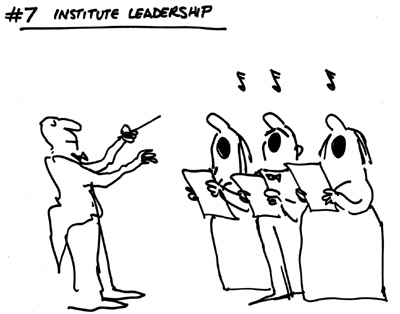
Point Seven - Institute Leadership. 
Dr. Deming calls upon management to lead rather than manage.  Simple statement but what does it really mean for us as leaders?  Well I'm pretty confident that if you were to talk to many of our frontline staff and management personnel they would provide you with countless examples of where they felt they were being "managed", not "led".  This bias towards "management" is without doubt enhanced by the immense pressure the health system is under to perform and achieve better results.  An unfortunate "management" response is to exercise greater control and oversight to make sure results get better.  More often than not efforts of this nature only seem to put more barriers in the way of getting good work done - more reports to generate, more signatures to get, more unreasonable timelines to meet, multiple and conflicting demands, and failure to hear and act upon input and recommendations from staff. 

Point Eight - Drive Out Fear.

Maybe fear appears an effective tool to get results in the short-term, but not if you are trying to create a high-performing organization for the long-term.  With fear in an organization there cannot be open communication, innovation, and teamwork - and these are all required for an organization to achieve the full measure of its potential.  Leadership of any organization - and at all levels of the organization - must actively model open communication, encourage appropriate risk taking and innovation, and promote teamwork from the board room, to the executive suite through to the front lines of operations.  With fear in place an organization shall continue to squander the full potential of its people and the organization to the detriment of the those it purports to serve.

Point Ten - Eliminate Slogans, Exhortations and Targets for the Workforce.

Everybody needs to measure performance.  Deming did not intend, nor do I suggest, that system performance not be evaluated on an ongoing basis.  Rather, what Point Ten addresses is the notion of trying to assess an individual's performance without reference to the system in which that individual works.  If an individual is prevented from achieving higher levels of performance by a system (that leadership has created or allowed to be created) then performance managing an employee, setting new targets for them to achieve, and giving them "motivational" speeches will have little impact on performance.  It is far more likely that such efforts will actually cause frustration, demoralization and reduced performance.  Deming's red bead experiment is a great illustration of this principle - given an equal number of red and white beads, an employee is tasked with collecting only white beads with an employer-provided scoop or paddle.  Inevitably, the employee collects some red beads in their assigned task.  As a result of "failing" in their assigned task, the employee may be given further direction by their supervisor, there may be encouragement to do better, they may be applauded if their red bead count has gone down, or they may be chastised if their red bead count goes up.  Regardless, their individual effort and various interventions at the personal level will have no impact on actual outcome.  It's like expecting employee engagement scores in an organization to go up simply by saying that the target is 10 out of 10 on the next engagement survey.  Only by changing the system and the organizational environment will better, more consistent results be achieved.  I see a strong correlation between Point Ten and the need to Drive Out Fear from an organization as noted earlier.  In fact, I believe that what leaders often create by exhortations to do better is an environment in which results and information are hidden through fear rather than being actively discovered.  And only by discovery can we improve.

Point Twelve - Remove Barriers to Pride of Workmanship.

In this point, Deming was referring to unclear expectations, lack of timely feedback (or any feedback), lack of training and support, and systems that focused on short-term results rather than long-term goals.  Staff and front-line managers are often frustrated by multiple tasks or changing priorities (see Point Seven) as leaders change focus or react to external stimuli without, it seems, due regard to long-term objectives or stated core values.  And unfortunately, more than one of us can relate to the fear that the performance evaluation process creates in us - either as provider or receiver of the experience.  Too often this is because we establish the evaluation process as a one-time event, not as a continual process of discussion, engagement and opportunity.  There is a need too to ensure that the evaluation process becomes an opportunity for leaders and staff alike to identify and invest in skills and intellect.  It is also a great opportunity for leaders to model desired behaviours and reinforce common goals.  On this latter point, I firmly believe that there must be a high degree of visibility and sincere engagement with internal audiences on par with leadership visibility and engagement with external audiences.  Without the kind of internal alignment that I believe comes from such effort the ability to deliver on commitments to external audiences and customers stands on shaky ground.

Deming's principles were valid guideposts when penned 60 years ago.  They were valid guideposts last year.  They remain as valid guideposts today.
______________________________

Greg Hadubiak, MHSA, FACHE, CEC, PCC
TEC Canada Chair/Executive Coach/Senior Consultant
hadubiak@wmc.ca

Helping leaders realize their strengths and enabling organizations to achieve their potential through the application of my leadership experience and coaching skills. I act as a point of leverage for my clients. I AM their Force Multiplier.

Friday, September 6, 2013

Charisma and Leadership

Over the past couple of months in my executive coaching practice a few of my clients have expressed a desire to be more charismatic.  They see this as a necessary and required personality trait or skill that will allow them to become a better leader in their current position or to advance to the next stage of their career.  As they present this thought they express a desire to be like other leaders they have seen or experienced - leaders that stride powerfully into a room, articulate clearly their thoughts and directions, and apparently energize others to move forward on an initiative.  On the surface my clients seem to equate being charismatic with being an effective leader.

In my role as executive coach I have explored this perspective in some depth - what is it about being charismatic that equates to effective leadership for my clients?  As we probe these expressions of how they want to be as a leader other words and phrases come to the surface.  Those terms include "confident", "articulate", "inspiring", "competent", "energizing" and so forth.  Personally, I find these expressions of leadership more comforting, insightful and useful than a desire to be charismatic.  My point of view is that charisma may not be a true reflection of leadership acumen.  Rather, it can too often mask a lack of competence or character that in the long-term is detrimental to organizational success.  In my experience, charisma can simply be glitz and glam, whereas competence and character sustain and inspire long-term personal and organizational success.  Worse yet, charisma or charm can hide a lack of skill, some truly flawed personalities or an ugly agenda - no shortage of charismatic dictators in our world's history that have ultimately led their organizations or nations to an inglorious end.

The reality in recruitment and promotion to leadership positions does, however, lend some credence to the perspectives put forward by my clients.  We can all identify examples of leaders who have been selected or chosen because of how powerfully they present themselves in an interview or in a variety of public forums.  They are extremely effective in engaging with and making strong impressions on others.  They often hold strong opinions and are not afraid to push their positions forward.  They often possess a strong personality that in many cases simply overwhelms those around them.  They are crystal clear about what they want and what it will take to get there.  They also are usually quite effective in managing up.  As a result they do in fact often achieve positions of leadership or influence.  Why wouldn't my clients want to aspire to emulate these role models?

Don't get me wrong.  Being likable, charming, and charismatic are great qualities to have. This type of skill set and ability to connect with and convince stakeholders and decision makers is a critical business skill.  Being comfortable in being "on stage" and networking is certainly an asset when it comes to achieving an organization's objectives.  To the extent that a leader can galvanize their followers or stakeholders around a common and laudable cause or objective well that's a skill to be fully exploited. 

However, I suggest that charisma is not nearly enough to be an effective leader.  At least not over the long haul.  A charismatic leader without competence, character, compassion and commitment can be a destructive and dangerous force.  This is particularly the case when the goals of the leader are focused more on personal gain than organizational success.  Relying solely or heavily on charisma without some deeper substance, skill or commitment may work for a while.  It may be particularly effective if a strong team can carry a leader for some period of time.  However, once that initial grace period is over I believe effective leadership has to be supported by a more complete skill set.

So nothing wrong with aspiring to be charismatic and inspiring.  However, no leader is effective with only one arrow in his quiver or one tool in her toolbox.  So for my clients and for other aspiring leaders I encourage you to continue to work on developing other required leadership skills and capacities.  In addition, as and when you have the opportunity, whether as part of a governing body or a manager looking at a leadership hire, I implore you to look beyond a well-written resume and strong interview skills.  Dig deeper to understand the track record of your prospective leader.  Dig deeper with references and other means of validation to understand the true leadership skill set that is presenting to you.  Above all else, look for and test whether your prospective leader is going to be a strong representative of your mission, vision and values.  Your leadership choice will certainly define your organization - hopefully in the way you would want.
______________________________

Greg Hadubiak, MHSA, FACHE, CEC, PCC
TEC Canada Chair/Executive Coach/Senior Consultant
hadubiak@wmc.ca

Helping leaders realize their strengths and enabling organizations to achieve their potential through the application of my leadership experience and coaching skills. I act as a point of leverage for my clients. I AM their Force Multiplier.


Friday, August 30, 2013

What's Your Bottom Line?

The public sector in Alberta is again facing significant financial challenges.  The result of which is that we are seeing some agonizing changes in program and service delivery offerings.  These changes are certainly impacting staff and in some cases impacting students, patients, and others who have come to expect certain things from these organizations.  These issues and concerns are certainly not just the purview of the public sector, nor are they unique to Alberta.  We have all seen a variety of headlines over the years about downsizing in the manufacturing sector, boom and bust within oil and gas, and the dramatic changes in the auto industry.  No sector or organization is immune to changes in markets or funding that causes it to rethink how it does its work.

Even in the not-for-profit sector, where I have spent much of my career, one iconic phrase that has gained currency is "No margin, no mission."  The message being reinforced through this phrase was that if an organization couldn't turn a profit or manage to its budget it could cease to exist and thus be in no position to live its values or achieve its purpose. This phrase came to hold some currency and was subsequently used to justify difficult and even harsh decisions through to and including program changes, staff layoffs, facility closures, mergers and consolidations.  Regardless of industry, for many leaders, revenue, cost, black and red became (and is) the strategic imperative.  The bottom line was and is the bottom line.

This is despite the fact that if you were to talk to many leaders about what their organization's greatest asset and resource is many of them would respond with an emphatic "Our People!"  They might tout how much investment they have put into recruiting and training staff, how important their intellectual capital is to developing and sustaining their competitive edge, how staff in all types of positions are the face of the organization and create so many "moments of truth" with a range of stakeholders and clients on behalf of the business. 

Yet the reality of actions taken seems to fly in the face of these strongly stated commitments.  There do not seem to be many organizations that don't react with strength, urgency and conviction to slash budgets, reduce costs, or enhance profit when push comes to shove.  Often the first cuts fall on education, training and travel.  Salaries and benefits may also be tackled.  For unionized staff this may take the form of attempts to reopen collective agreements.  For non-unionized staff it may take the form of wage freezes.  More often than not that doesn't deal with all or even most of the financial requirements and staff changes rapidly follow.  This despite the fact that the human resources of the organization have been touted as the organization's greatest asset. 

This pattern of investment and divestment takes on a degree of regularity that makes for great fodder for a Dilbert cartoon.  I've been through more cycles of this than I can now recall in my former healthcare career where we would often invest significant time and resources in recruiting staff - even engaging in heavy overseas recruitment - and then within a year or two start a round of layoffs to meet a new budgetary challenge.  The larger economy parallels this experience.  For example, business media is starting to note recovery in the US economy and with this rebound the topic of employee retention is getting more play. 

So what should the true bottom line for one's organization be?  To me it hardly seems logical to manage any enterprise, to sustain forward momentum, and achieve long-term objectives by divesting and then reinvesting in staff every couple of years.  I may be cynical, but it appears that too many leaders take more care in the investment and maintenance of the physical assets of their organizations (e.g., buildings, equipment) than they do in their staff.  And yet without skilled, qualified, motivated and committed staff those physical assets stand idle or are not used to best effect.  I don't believe most leaders would make millions of dollars in investments in buildings and equipment only to idle or shutter them only a couple of years later.  It would seem that doing so on a regular basis would start to call into question leadership competence...or so one would think...
I have already shown my bias as to what I think an organization's bottom line should be.  I do believe that we should truly commit to the principle that, as leaders, we so often espouse.  Namely that our staff are our greatest resource.  What are the implications of making this type of commitment real?  For one, I believe as leaders we need to exercise diligence on both sides of the equation of creating/expanding programs, services or product lines as we do in reducing/ eliminating them.  As leaders our goal should be to create some semblance of stability and measured response to environmental pressures.  I believe we should endeavor to create a plan for product, program and service delivery that is sustainable and is informed by our past experiences and future - realistic - expectations. 

Have I just crafted a fairy-tale scenario?  Is this a realistic perspective on how to handle pressing financial considerations?  Is this at all doable?  For some organizations the answer is evidently yes.

Just this week, CNN Money (August 27, 2013) reported that Starbucks would not be following the lead of other US companies in cutting staff or benefits as a result of healthcare reform south of the border.  Starbuck's CEO, Howard Schultz, took a stand for its company and said that its current benefits and commitment to staff was non-negotiable.  This is no small commitment.  In 2010, benefits cost the company $300 million.  That's more than the chain paid for coffee in the same year.  Starbucks has made their commitment to staff - their bottom line - real.  I expect that this commitment puts them at some advantage in recruiting and retaining the most important asset in any enterprise - it's people.

So what's your bottom line as a leader?  Do your words as a leader match your actions?  Does your vision extend beyond the next quarter's financial results? 
______________________________

Greg Hadubiak, MHSA, FACHE, CEC, PCC
TEC Canada Chair/Executive Coach/Senior Consultant
hadubiak@wmc.ca

Helping leaders realize their strengths and enabling organizations to achieve their potential through the application of my leadership experience and coaching skills. I act as a point of leverage for my clients. I AM their Force Multiplier.


Wednesday, August 14, 2013

Change - Only Effective if you Make it Stick!

The only constant in life is change.

Amazingly enough this quote comes from a Greek philosopher by the name of Heraclitus (500 BC) and not from a thought leader of our present day.  Regardless, I expect that most of us can relate to the sentiment expressed by Heraclitus and in fact might consider it to be an understatement in today's environment.  As organizations, leaders and individuals we seem to be constantly bombarded by and responding to change.  Just as frequently, leaders see or believe in the need to proactively initiate change to better position their organizations for future success - or even survival. 

One would think with so much at stake for organizations in these change initiatives that nothing would be left to chance in ensuring success.  The track record, however, is not so encouraging.  A variety of sources identify the success rate for major change initiatives as being between 20% and 40%.  Put another way, fully 60% to 80% of change efforts fail to achieve or sustain the objectives for which the change effort was established! An abysmal figure given the significance of the resources devoted to these initiatives.  Add on to these direct costs the lost opportunity cost to an organization (e.g., what else could have been done with that time, energy and money) and the impact can truly be staggering.  Indeed, some organizations fail so completely at implementing change that they cease to exist.

What accounts for this staggering rate of failure?  And what are the critical factors in making sure that change can be managed and the gains sustained?  This latter question was recently tackled by several of my colleagues and myself within the context of an academic exercise.  We could all bring to bear our personal experience of success and failure in organizational change initiatives. 

Not surprisingly (maybe particularly so for a blog focused on leadership) the first critical success factor identified was the need for sustained, visible and credible senior leadership commitment.  Too often - in my experience - senior leaders are great at calling out the need for change, are visible at the launch of a change initiative, or can tell others what new behaviors are expected but fail to stay intimately involved in the change initiative for the duration.  Major change initiatives need constant engagement of leaders, role models and executive sponsors.  Major change initiatives take time to fully realize their potential and success does not come without overcoming bumps and barriers along the way.  If senior leadership is only fleetingly or superficially engaged failure of the change initiative is a near certainty.  (For additional perspective on the importance of executive sponsorship check out http://www.wmc.ca/ebooks/sponsorship/)

Directly related to the need for senior leadership commitment is a requirement for a compelling vision for change - why is the change necessary, what are the expectations for the change initiative, what will success look like, what steps must be taken, how will people within the organization be impacted, and so on.  If leadership of an organization cannot develop and articulate a compelling vision for the initiative natural resistance to change will take over and the odds of successful implementation will be significantly diminished. 

Following immediately on the need for a compelling vision is the need for a real and substantive plan for the change initiative.  It's not just that a major change initiative needs to have a detailed plan from initiation, through to key milestones, conclusion, evaluation and ongoing monitoring.  It also won't be just enough to make sure that there are change champions in place or training initiated as required.  Leaders must also ensure that the change initiative is complemented by and coordinated with other ongoing organizational initiatives or existing systems or ways of doing things.  A lack of internal alignment means that organizational gears will grind against each other slowing if not entirely defeating hoped for results. 

Communicate, communicate, communicate.  There cannot be enough communication in all phases of the change initiative.  A communication plan must be created and implemented in lock step with key milestones of the overall change initiative.  This plan must take into account the appropriate role for senior leaders, middle managers, front-line supervisors and other change champions - each of whom will play a different but critical role in keeping information flow alive and rumors at bay.  There will certainly have to be internal consistency to the messages being sent.  However, timing and tailoring of content to a variety of stakeholders will have to account for different needs, perspectives and capacities of the different audiences.  This is no small job.  And the communication should be two-way, allowing for feedback/evaluation as the initiative is rolled out.  This feedback loop can help identify problems quickly and reduce points of resistance.
Target and celebrate early wins.  It's important to demonstrate as soon as is possible some of the success that the initiative is achieving.  People will need positive reinforcement for the effort they are putting in and for the sacrifices they are making.  Reward and recognize along the way.  Failure to do so will at best induce apathy in change management efforts and at worst will lead to entrenchment in the old way of doing things.  A couple of cautionary notes though - make sure the win is real and the reward authentic.  We are all intelligent enough to sniff out a lack of reality when we are being falsely complimented.  Credibility is key.  Just as important is making sure that leadership does not prematurely announce "victory" for the change initiative.  Any major change requires a significant investment of time before it truly supplants past behaviors.  Don't get distracted and complacent only yards from the finish line.  You will find yourself back at start before you know it and wondering what happened. 

One last note.  It may, again, seem self-evident but I believe that an organization can only sustain so much change at any one time.  Self-evident as it may be it appears that too many leaders still try to defy the odds and take on all comers.  So what's the answer to how many change initiatives?  I don't have a magic number but I believe there are a couple of parameters to be considered.  First, if we reconsider  the critical role of the senior leader or executive sponsor a key question should be how many change initiatives can these individuals effectively lead.  I suggest that this number is realistically not more than two.  If we are talking about major change initiatives - stacked on top of regular, operational responsibilities - I don't believe any leader/executive sponsor can effectively manage more than that.  Second, just because an executive team might be comprised of 6, 10 or 15 individuals it should in no way imply that 12, 20 or 30 change initiatives can be managed/tolerated by the organization.  Again, if we are talking about major change initiatives, it can be expected that more than one senior leader and department in the organization will be impacted by or play a role in supporting each initiative.  So as a leader you are not just leading two initiatives but also being looked to for support in perhaps another six.  And staff of the organization are going to have to somehow manage, navigate, and prioritize all of these "critical" demands from their senior leadership.  A truly unenviable task.

The only thing that is constant is change.  This may be particularly true if as a leader you don't do change right.  Do it right, do it well, and make it stick.

______________________________

Greg Hadubiak, MHSA, FACHE, CEC, PCC
TEC Canada Chair/Executive Coach/Senior Consultant
hadubiak@wmc.ca

Helping leaders realize their strengths and enabling organizations to achieve their potential through the application of my leadership experience and coaching skills. I act as a point of leverage for my clients. I AM their Force Multiplier.

Thursday, July 11, 2013

Tolerating Mediocre Leadership

I've been hearing more and more the lament of "where is the leadership?" from a variety of quarters over the past few years.  I'm sure most would not be surprised that much of that concern is often focused on the top echelons of our organizations.  Most often it is easiest to critique to those in the C-suite as they are the most visible, are paid the most, and are the ones that shoulder the blame for things gone wrong or not quite right in their organizations.  Just as frequently, they are the ones most under scrutiny by the media and the public in general. This is true for all types of organizations - political parties, large private sector companies, and public sector and not-for-profit ventures. 

What might be surprising to hear, is that many of our top leaders express similar discontent with the caliber of leadership demonstrated by those who report to them or that lead business units throughout their organization.

Despite these laments, misgivings and general feelings of discontent our organizations are seemingly prepared to tolerate this leadership mediocrity.  If not, rather than complaining about the situation wouldn't they have taken concrete steps to change or improve leadership in their organization?  And that doesn't mean just instituting a leadership development program, rather it means modeling and rewarding desired leadership behaviors.  A recent quote from Chief of Army Lieutenant General David Morrison (Australia) has been making the rounds of late and seems appropriate in this context - "The standard you walk past is the standard you accept."  Worse yet, I believe that not only do we walk past or tolerate mediocre leadership but many of our organizations unconsciously reward sub-standard leadership.  We support blind adherence to rules and regulations, support a risk management and avoidance approach rather than one of risk taking, and appreciate those who play it safe while holding back those who would be creative and innovative.  We may pay lip service to a desired level of leadership but our actions speak louder than our words.

So why does this situation exist?  In some circumstances, it is evident that as leaders in our own right we have not laid out clear expectations for leadership performance.  To the extent that this doesn't happen the natural inclination of many new leaders/managers is to play it safe.  The rationale approach is "don't make too many mistakes" in our first few days on the job.  Moreover, in large organizations - unless there is an existing dynamic of innovation and risk-taking - the prevailing work culture tends to force a new manager to a pre-existing norm and standard of performance.  Conformity is at the very least subconsciously rewarded and enforced.  This hidden or not so hidden culture can also often be reinforced by a variety of formal organizational structures (e.g., compensation systems) that have not been reformed and changed to support a style of leadership that the organization says it wants.

Just as important as this lack of clarity of expectations is the inability or unwillingness of leaders to have honest conversations about performance or lack thereof.  This includes a willingness on the part of any leader to interrogate their own reality, assess their own leadership performance, and be open to feedback from their direct reports and others.  This unwillingness and unease to confront the gap between words and actions brings us back to Lieutenant General David Morrison's statement above.  In many respects, we get the leadership we deserve as much through our inaction as through positive engagement with our constituents.  Our lack of action speaks volumes.  If we are to raise the standard for leadership in our organizations we must recognize a need to be clear and assertive about our expectations.  This doesn't mean being engaged in perpetual conflict and performance management conversations (I hope) but it does mean having the courage of your stated convictions.  That's really what effective management and leadership is all about.

There are a couple of other explanations about why leadership is the way it is in many of our organizations.  One disturbing conclusion comes from an assumption that leadership mediocrity has become more the norm than the exception and as a result we no longer really distinguish between good and bad leadership.  A bit of the boiled frog analogy.  A frightening thought from my viewpoint.  In fact, perhaps we are simply looking for managers and leaders to fill a slot on the org chart, get along with as many people as possible and help us create a "no news is good news" culture. 

An even more disturbing thought from my perspective is that perhaps the definition of leadership truly has shifted.  Perhaps the collective "we" really does not want or value courageous leaders - those leaders who have bold vision, are prepared to take on the sacred cows, embrace and foster change, recognize that past approaches can't solve current problems and future challenges, and actively seek to disrupt the status quo through innovation, creativity, transparency and engagement.  I hope I am wrong!

It is my sincere - and maybe naïve and idealistic - hope that our leadership lament DOES imply a collective desire to recruit, support and develop leaders who are willing to challenge the status quo, offer new ideas and energy, authentically engage all constituents, and ultimately are prepared to take on a servant leadership mantle to co-create better organizational responses to pressing requirements of our new and ever-dynamic reality.  Mediocrity in leadership at all levels clearly is not going to move us beyond our current challenges.
______________________________

Greg Hadubiak, MHSA, FACHE, CEC, PCC
TEC Canada Chair/Executive Coach/Senior Consultant
hadubiak@wmc.ca

Helping leaders realize their strengths and enabling organizations to achieve their potential through the application of my leadership experience and coaching skills. I act as a point of leverage for my clients. I AM their Force Multiplier.


Friday, June 14, 2013

Credibility and Integrity

This past week I was pleased to have the opportunity to connect with two people at the opposite ends of the career spectrum.  My first meeting was with a young man starting to chart his career course, having recently completed some academic upgrading and in the throes of a job search.  A man focused and intent on making his mark in the world.  Later that same week I renewed acquaintances with a colleague of mine that I had last worked with 10 or more years ago.  From my perspective, an accomplished leader, somebody who has made key contributions in his home province and across Canada.  A man who has already made his mark but remains focused on continuing to do so.

Two people at quite different stages of life and career.  Yet we ended up covering a least one topic in common.  How to maintain one's credibility and integrity during challenging times, when to stand up for what you believe in and when is a battle important enough to justify standing up and bearing the potential cost - including a radical change in one's career path.  There certainly has been more than enough in the news over the last few weeks to bring up this topic for discussion.  This includes the relatively unprecedented resignation of a Member of Parliament from the governing party and the battle between the Board of Alberta Health Services and the Minister of Health over senior executive compensation and, more particularly, at risk pay or bonuses. 

In both cases, the protagonists took a stand on a principle - transparency, democracy, autonomy, integrity, authority, accountability - to justify a stand and an action.  A high price was paid by the principals in each case.  The MP now sits as an independent, has lost access to government resources, and likely faces a huge uphill battle to be reelected if he chooses to run in the next federal election.  The ruling party faces the dilemma of being accused by one of its former stalwarts of turning away from its fundamental values and principles that first brought it to power.  In Alberta, the Board of AHS was summarily dismissed from their roles by the Minister of Health.  The Minister of Health and the provincial government now face public scrutiny and political attack for making such drastic move.  It is likely that each group or individual would identify that they acted on a fundamental principle, took a stand to maintain their personal or organizational integrity, and further needed to do so to maintain their credibility.

I'm not going to use this forum to land on either side of these particular issues although I do have a decided view in both circumstances.  Instead, I see value in using these stories as a base from which to address a question posed to me by my young colleague - when is the right time to take a stand on an issue?  No small question.  A similar topic came up in conversation with my senior colleague.  However, in that discussion we did not need to deal with hypotheticals.  We had both lived the experience of dealing with challenging situations that called us to make choices - could we live with and be party to a particular decision or direction OR would we advocate for something different, even if we could reasonably expect negative consequences to our current positions?  Both of us could recount in clear detail the circumstances in which we had held true to core beliefs and values.  All the more memorable no doubt since the outcome was indeed a radical change in our employment status.

My senior colleague and I both agreed that there was no "scientific method" by which we had determined which hill to die on.  The decision was arrived at more subjectively.  We did agree, however, that there were fundamental values at play for the both of us.  Moreover, these values did not simply exist or demonstrate themselves in our work environments.  We both saw a consistency and authenticity at play as we brought our whole selves to work that was a product of multiple experiences in our personal and professional lives.  It was clear as well to me that both of us were in fact clear on what our personal lines in the sand were.  We knew what was important to us and were not prepared to pay any price to sustain our positions.  It boiled down to what was the "right thing to do " based on our core beliefs.

When I tried to answer the question of my young colleague in this regard I immediately suggested that I perhaps wasn't the best person to ask for advice on when or when not to take a stand.  While I wouldn't describe myself as somebody who sees issues in purely black and white terms I definitely have a pronounced sense of right and wrong, and maybe more particularly a perspective on what seems fair.  So, the reality of that for me has been a decided willingness to tilt at windmills, being a champion of difficult causes and being the first one over the hill to take the spear - really prepared to make a difference in my sphere of influence. 

What I did recommend was that my young colleague seek clarity on his personal values.  I have spoken to this in some of my previous blog entries (e.g., Courage...or calculation, Charting Your Leadership Course) and would continue to emphasize that if you don't clearly identify what's critically important for yourself you will likely be making compromise after compromise in your life.  A key symptom of having sold away yourself to the decisions and values of others is that you will no longer find joy in your work.  In fact, I would suggest that you could be downright miserable, disenchanted, demoralized and fatigued as you consider each day's work.  You no longer serve a purpose, your purpose, with credibility and integrity.

Finally credibility and integrity aren't created overnight or simply because one holds high position or ultimate power.  Credibility and integrity come from a well-established set of values, consistently articulated AND ACTED UPON, over a long period of time.  An individual or organization rapidly loses credibility and does damage to the perception of integrity if decisions take on the character of convenience or expediency.  I have often suggested that credibility and integrity can be looked upon as a personal credit rating.  It takes a long time to build up your credit rating.  However, make too many withdrawals or miss too many payments and you rapidly throw that good work out the window.  It all catches up to you at some point. 


Be clear about your values and what's important to you, act consistently with those values in your personal and professional life, and be prepared to take YOUR stand when you are being pushed away from your core self.  Others are watching you, evaluating your strength and your convictions, but you are in control of your personal credit rating - your credibility and integrity. 

It's all about you and your leadership. 
______________________________

Greg Hadubiak, MHSA, FACHE, CEC, PCC
TEC Canada Chair/Executive Coach/Senior Consultant
hadubiak@wmc.ca

Helping leaders realize their strengths and enabling organizations to achieve their potential through the application of my leadership experience and coaching skills. I act as a point of leverage for my clients. I AM their Force Multiplier.

Thursday, May 23, 2013

Can You Overcome Your Success?

All of us can probably identify a past or current scenario where an all-star leader seems to have plateaued.  They have shown early promise.  They have taken on series after series of challenging assignments and knocked those opportunities out of the park.  They seemed destined for even greater success down the road.  Mysteriously, however, something seems to have gone amiss.  There may not be problems as such, but the energy and drive that characterized past performance is gone and the pace of successful projects undertaken and completed seems to have slowed.  There may even be a range of seemingly valid reasons offered for this change - assignments are more challenging, the external environment is less favourable or even hostile to success, and there may have been turnover in key members of their support team.  Regardless, the fact is the particular leader doesn't seem to be moving the goalposts like they used to. 

Sometimes we are apt to describe this scenario as the "Peter Principle" - basically that somebody keeps getting promoted or considered for more complex and challenging leadership opportunities until they succeed in getting a position for which they do not have the requisite skills and abilities.  In this regard, I suggest that this may not be a particular failure of the individual leader, but perhaps of the organization or superior who hired or promoted them into the opportunity.  Was there a realistic assessment of whether the candidate did indeed have the leadership toolkit to succeed at the next level?  Or did both parties underestimate the size of the jump, overestimate the candidate's current skills, or neglect to assess the candidate's ability and willingness to learn.

It's this last point that I believe we too often ignore - either for ourselves as leaders or when being evaluated by others for more senior roles.  A particular challenge of success is that it can reinforce a pattern of behavior - it worked before, why wouldn't it work again?  In many sectors we do this particularly when promoting technically skilled people to their first management position.  They are a great nurse, technician, or carpenter and we then presume that what made them great at that level will allow them to easily move into a role a manger, supervisor or foreman. 

Another analogy that we're probably familiar with is that of the tradesperson who is particularly skilled at using a hammer.  If you have great skill and success with this one tool, every situation would seem to call for a hammer, until you have a plumbing problem to solve, or need to lay out a concrete foundation and so on.  The same holds true for leadership.  If you've been recognized and successful by using a limited set of tools the incentive to expand your repertoire is similarly limited.  Don't fix it if it isn't broken could be the mantra.  In fact, there may be a disincentive to invest in ongoing training, education and learning.  After all, there is real cost associated with new or ongoing learning.  Moreover, you have to have the humility to recognize the need for further development.  It may simply be easier to blame other factors - and people - for hitting the wall.

This unwillingness to learn, change and adapt can manifest itself in the form of complacency, defensiveness and even arrogance - don't need it, not me, I'm already great!  Regardless of the form it takes, the consequences for an individual leader, and the business unit or organization they lead, can be significant.  If remedial action is not taken in some reasonable timeframe business opportunities can be missed, competitive threats can be mistakenly dismissed and other organizational talent can be lost.  Eventually either the leader or organization - and sometimes both - pay a heavy price. More than one business article has been written laying out a sad path of decline for a once seemingly powerful organization because of a key leader failing to adapt to new requirements.

So how to overcome this Achilles heel of success?  First and foremost, I believe is a need for powerful personal humility.  I have always believed that the surest path to personal failure and irrelevance as a leader is to ever believe that all learning is done.  As noted before, a leader can arrive at this undesirable state either through complacency or arrogance.  This scenario is more untenable today than it has ever been with knowledge, technology and competitive factors seemingly changing daily - or even hourly!  If we think we are the experts in something just wait a minute. 

Second, today's leaders must recognize that these rapid changes demand reliance on a team of people to succeed.  Leadership - particularly at a senior level - is all about getting things accomplished by working with and achieving through others.  It is impossible to succeed without tapping into and effectively utilizing the FULL collective knowledge, skills and abilities of the team.  A leader these days perhaps needs to consider themselves less of a boss and more of a facilitator and synthesizer of knowledge that exists amongst the team. 

Closely related to this ability to work with and achieve through others - and the personal humility noted above - is a readiness to be fully open, and demanding of, honest assessments and feedback from the team and others about what is working and what is not working.  This willingness to be open to feedback must be truly authentic otherwise followers will quickly realize that their personal success and survival depends on parroting the party line.  Moreover, they will likely start looking for ways to distance themselves from any negative fallout if in fact their un-voiced expectations of failure come to pass.  To ensure long-term success, a leader has to be able to hear the good with the bad and see all feedback as an opportunity for further growth.  The leader must not only expect the full spectrum of feedback they must actively crave and pursue it.

Finally, a leader needs to continuously and vigorously evaluate his personal toolkit.  Just because a certain style, approach, frame of reference, set of assumptions or model worked in a previous position, or last year, or yesterday is no guarantee of success in meeting the next challenge.  In fact, the odds are decidedly stacked against you that your beloved metaphorical hammer will continue to do the trick.  As a leader you need to be constantly evaluating yourself, your toolkit and your frame of mind.  To continue the analogy, you need to be constantly sharpening your saw, acquiring new tools, and honing your overall leadership skills.  And you are going to have be prepared to hear and learn from a number of "instructors" or "tradespeople" along the way - your staff, your peers, colleagues, coaches, and others.  They have much to teach you if you are ready to learn.

Don't rest on your laurels.  Don't assume that what got you to your current leadership position is going to help you get to the next level - or even keep you where you are.  As a leader you need to invest as much in your own self-evaluation and redevelopment as you likely take your own organization through on a daily, monthly and yearly basis. 

Assess yourself honestly, be open to feedback, and embrace your ongoing development as a leader. 
______________________________

Greg Hadubiak, MHSA, FACHE, CEC, PCC
TEC Canada Chair/Executive Coach/Senior Consultant
hadubiak@wmc.ca

Helping leaders realize their strengths and enabling organizations to achieve their potential through the application of my leadership experience and coaching skills. I act as a point of leverage for my clients. I AM their Force Multiplier.


Thursday, May 9, 2013

Bullying - Part of Your Organization's Culture?

No doubt we are all aware of a multitude of tragic scenarios that have played out with increasing regularity in our local communities and across our respective nations - children and youth subjected to intense and sustained harassment that only gains attention or action after they have taken their own lives in a desperate attempt at escape.  Invariably as a community, as parents, as human beings we individually and collectively express shock and dismay that such a tragedy could take place.  Invariably we ask how and why could this happen, what should have been done to identify and stop the bullying, and what we should do now.  We seem particularly shocked that children could perpetrate such abuse. 

I'm not sure why we are so surprised.  Judging by my own experience and that of others an undercurrent of bullying exists within our broader society and in our workplaces.  Our youth are unfortunately just modeling our own "adult" and "professional" behaviors.

I want to first point out that by starting this entry in the way I have that I in no way intend to diminish the very real tragedies that have taken place.  I do, however, believe it is useful as a starting point in highlighting the fact that we unfortunately do not leave that reality behind once we move on from elementary school.  Inadvertently or not, our leadership styles and our work cultures also tolerate, sustain, and even foster bullying.  Just as there are not, and should not be, bystanders in dealing with bullying of our youth a similar sentiment must hold true in our organizations.

There may be more than a few questions rattling around your head at this point, not least of which may be "Does bullying really exist in my organization?"  and "What does bullying even look like?"  Or perhaps like me, and others who have reached out to me, you know all too well the face of bullying from your past or current work.  My personal experiences have run the gamut - leaders abusing their secretaries and subordinates, physicians intimidating their colleagues/nursing staff/ managers, union presidents running roughshod over their members, peers targeting peers, and on and on.  The list is endless.  Perhaps we have become a little bit less tolerant of such behavior and a bit more sophisticated in our response than when I first started my career but such behavior is still far too frequent for my liking.

What does this have to do with leadership?  Everything.  First, as leaders we have to be conscious of our own potential (or reality) for being the bully.  In our roles we yield great power and with great power comes great responsibility and accountability.  By the very nature of our roles we can intimidate and by using our positional authority - throwing our weight around - we can cow others into doing what we want them to do.  As leaders we can feel fully justified in doing so - we have been given the authority, we have earned the leadership role, we have been given a mandate, my staff don't/can't see the reality like I do, I have a professional designation (e.g., MBA, MD) that gives me even more credibility, and so on and so forth.  But is this roughshod approach real leadership?  It's not many subordinates who have the courage or temerity to hold fast in a point of view that is counter to what their boss is proposing.  Even less so if the track record for being contrary includes personal criticism, opinions being denigrated, being undermined on other projects or opportunities at a later date (i.e., payback), being overlooked for promotions or raises, or even being threatened with - or experiencing - job loss.  Even less so if the bullying behavior has proceeded with impunity before. 

If we are not the bullying leader we have a role in supporting and creating a culture that doesn't tolerate such behavior.  Leaving aside the moral obligation we have as leaders to prevent and eliminate bullying in the workplace, there are some very practical and self-serving reasons to deal with bullies.  The implications to individual and organizational performance are not to be underestimated.  Many authors and researchers approach this subject matter as a workplace health and safety issue.  As it should be.  And as with a variety of workplace health and safety issues the ripple effect of a bully's actions - especially if in a leadership role - equates to any or all of lower staff productivity and effectiveness, poor customer service, increased absenteeism, lower morale, poor team work, higher employee turnover, and very real (and costly) health issues. 

Morally and ethically we are also called to act as leaders and deal with bullying behavior.  Vested with our own positional and moral authority we are called to stand up for those who can't stand up for themselves and uphold the stated values of our organizations or professions.  I'm fairly confident that no organization on record nor any professional association has as one of its tenets a commitment to fostering a culture of bullying. 

All this being said we could still likely describe recent and ongoing examples of bullying in our organizations.  So what needs to happen to really make a change? As already noted, I'm not aware of any organization or professional association that promotes bullying or abuse or harassment in any form.  Quite the contrary.  So I don't believe that we need more written codes of conduct, regulations, policies, procedures or similar written statements on the matter.  What we need is more courage and action, not more paper.  We need to be leaders and carry through with the obligations we have signed on to.  We need to not dismiss bullying behavior as an aberration or one-time event.  We need to not condone such behavior because our boss, or peer, or subordinate or member of our staff "gets results".  And our response has to be far more than providing counseling to those experiencing workplace bullying, or shifting them to other duties, or giving them paid leave to recover.  Most of these types of actions really do nothing more than blame the victim - whether that is intended or not. 

Harken back to your days in elementary school.  Think about the kids being harassed and bullied today.  The options for response can seem limited.  Often a bully will threaten further - and harsher - retribution if the victim rats them out.  Amazingly enough the victim can experience more isolation from coming forward - they will appear weak and a whiner in the eyes of the rest of their peers.  If somehow the victim does find the courage to bring the issue to an authority figure there is no guarantee that the cycle of abuse will stop. 

From what I've seen in organizations, the behaviors we adopted in school to get through are the same ones that many use to get through similar situations at work - silence, tolerance, gritting of our teeth, turn the other cheek, just trying to make it through another day of work, hoping that we won't have to encounter that leader, that peer, that professional who seems to go out of their way to bully and intimidate.  If they do get the courage to stand up to the bully, the processes we use seem to further draw out the pain and the opportunity for further abuse and retribution.  The bully gets to continue their work, they may have more "behind closed doors" opportunities to threaten, they have polished responses that amount to "he said/she said", and they may even pull out their own claims to now being themselves abused/harassed by these allegations.  The victims often despair of having raised their voice.  Their experience seems to send them a message - don't speak up, lay low, the cost is too high.  And that message is brought home not only to them but to all staff.

As leaders we must be the ones to stand up to the bullies just as we may have once done in school - head on.  There must be zero tolerance for such unprofessional behaviors.  There must be the courage to take action on the code of conducts that we have all either helped create or signed on to.  Are such efforts easy or pleasant?  Decidedly not!  But that is what our role as leaders entails.  And I speak from experience - I have been threatened by and stood up to so-called leaders, to members of my own Board of Directors, and to abusive physicians.  In too many of those cases I often stood alone.  In many of those cases I too became a subject of abuse and harassment - late night calls at home, threats of legal action, public vilification, and in-your-face "discussions".  My role as leader called me to protect those who couldn't protect themselves, who often just wanted to come to work do a good job and to have the opportunity to enjoy that work. 

Leadership is hard work and it takes courage.  As a leader you set the tone by your every action (or inaction) each day.  Do you have the courage to stand up and call out the bully that is in your work unit, that is your professional colleague, that is your peer - that is your boss?  Or are you content to let someone else pay the price for your inaction?


______________________________

Greg Hadubiak, MHSA, FACHE, CEC, PCC
TEC Canada Chair/Executive Coach/Senior Consultant
hadubiak@wmc.ca

Helping leaders realize their strengths and enabling organizations to achieve their potential through the application of my leadership experience and coaching skills. I act as a point of leverage for my clients. I AM their Force Multiplier.

Friday, April 26, 2013

Poise over Panic!

In my time as a manager/leader starting some twenty-five years ago, I've had the opportunity to work with and observe many leaders, managers and staff.  They have all helped me grow and develop my own leadership philosophy and style.  Sometimes I've learned great tools and techniques from them as they have navigated normal and not so normal situations.  But there have been just as many opportunities - and maybe more - where the lesson learned has been "I'll never do that!"

One of the areas of greatest learning has been in the experience of seeing how managers and leaders react to "adverse" events.  Those events have covered a spectrum of circumstances - poor (to deadly) service to clients, the out-of-the-blue call from a prominent political leader looking for action, a staff crisis, a building or equipment malfunction impacting service delivery, or media showing up without warning at your doorstep.  The set of circumstances is largely irrelevant for my blog other than in trying to convey that something bad has happened that needs to be addressed.  More importantly for me, is the range of leadership reactions these situations have engendered - which has been nothing short of extraordinary, educational and (in a perverse sort of way) highly entertaining.

For the intent of this blog and to highlight my point, I am going to focus on what I consider to be the negative side of these reactions.  In many cases, I write from direct experience or have otherwise observed the leadership response as it has unfolded.  Namely, a leadership reaction that actually becomes part of the crisis, or THE crisis, rather than a means of managing in and through it. 

All too often, and for too many in leadership positions, there is a tendency to lose one's head during a real or perceived crisis.  I emphasize perceived because I believe that in many situations leaders may overplay a set of circumstances and never step back for long enough to evaluate whether in fact there is a real crisis in need of management.  Up-front evaluation is an important first step.  Otherwise you are going to be expending a lot of unnecessary time and energy that probably could be put to better use. 

Beyond this initial evaluation, it appears that for some leaders running around, crying out that the proverbial sky is falling is somehow an effective way of ensuring that immediate, decisive and effective action is taken.  That's where I believe some leaders miss the point about what effective leadership is and should be about.  Too many react to a negative scenario by confusing immediate action or any action with effective action.  They seem to believe that only by providing an immediate response in a situation will they be perceived as being in control, responsible and competent.  The reality is often far different.  More often the sense they convey to staff and others around them is that they are in panic mode.  Rather than being a leader that manages the situation their reaction more often generates fear, stress and anxiety to everyone unfortunate to be caught up in the vortex of activity.

Aside from the mental distress that the leader is subjecting themselves and their team to, a "decisive" yet hasty reaction is just as likely (or more likely) to lead to the wrong decision as to the right one.  In most situations we rarely have 100% perfect information.  In crisis situations this is even more the case.  Therefore, crisis demands disciplined leadership, an ability to remain calm, and the strength to keep yourself and your team focused in order to solve the problem at hand.  In my experience, panic and performance excellence rarely go together.  A panicked reaction can often lead to more problems to solve.

A leader in crisis (versus a leader who manages through crisis) also creates a number of other negative impacts that may not be understood at the time or even later. First, in your haste to make a decision, you many not even be solving the right problem but merely papering over symptoms.  Second, by making a hasty decision you may inadvertently compromise your ability to achieve other more important objectives.  Third, rather than creating an effective and productive team you are more likely creating fear, reduced productivity, risk aversion and indecisiveness amongst your staff.  Ultimately, you are also doing damage to the perception of your leadership capacity - you are not creating an image of a confident and competent leader amongst your team, peers, superiors, or other stakeholders that can be looked to for strength in times of challenge.

So Keep Calm and Carry On!  I'm convinced that we don't see or experience as many crisis situations as we think we do.  Take the appropriate time to assess the situation.  And even when you do experience a true crisis, taking a deep breath before taking action is still a good tactic and a sign of confident, disciplined leader.  Your reaction will calm others, help them focus on doing the right things, and ensure understanding of all impacts of your actions.  I'm convinced that by taking a more measured and less panicked approach that you will make better decisions and the confidence in your leadership will be enhanced.

Leadership excellence means more poise and less panic. 


______________________________

Greg Hadubiak, MHSA, FACHE, CEC, PCC
TEC Canada Chair/Executive Coach/Senior Consultant
hadubiak@wmc.ca

Helping leaders realize their strengths and enabling organizations to achieve their potential through the application of my leadership experience and coaching skills. I act as a point of leverage for my clients. I AM their Force Multiplier.
Wednesday, April 10, 2013

Make your best people quit!

A very simple post to write today - because I didn't write it! I have shared this article on my LinkedIn page recently but realize that many of you are not connected to me in that way and so much of what is said here reflects my thoughts and experience - and the intent in creating my blog - that I thought it was something worth sharing again. 

Enjoy...and reflect on how you or your organization falls into these traps...and maybe do something about it!

----------

Hiring Wisdom: Top 10 Ways to Guarantee Your Best People Will Quit

© vladgrin - Fotolia.com
Here are 10 ways to guarantee that your best people will quit:

10. Treat everyone equally. This may sound good, but your employees are not equal. Some are worth more because they produce more results. The key is not to treat them equally, it is to treat them all fairly.
9. Tolerate mediocrity. A-players don’t have to or want to play with a bunch of C-players.
8. Have dumb rules. I did not say have no rules, I said don’t have dumb rules. Great employees want to have guidelines and direction, but they don’t want to have rules that get in the way of doing their jobs or that conflict with the values the company says are important.
7. Don’t recognize outstanding performance and contributions. Remember Psychology 101 — Behavior you want repeated needs to be rewarded immediately.
6. Don’t have any fun at work. Where’s the written rule that says work has to be serious? If you find it, rip it to shreds and stomp on it because the notion that work cannot be fun is actually counterproductive. The workplace should be fun. Find ways to make work and/or the work environment more relaxed and fun and you will have happy employees who look forward to coming to work each day.
5. Don’t keep your people informed. You’ve got to communicate not only the good, but also the bad and the ugly. If you don’t tell them, the rumor mill will.
4. Micromanage. Tell them what you want done and how you want it done. Don’t tell them why it needs to be done and why their job is important. Don’t ask for their input on how it could be done better.
3. Don’t develop an employee retention strategy. Employee retention deserves your attention every day. Make a list of the people you don’t want to lose and, next to each name, write down what you are doing or will do to ensure that person stays engaged and on board.
2. Don’t do employee retention interviews. Wait until a great employee is walking out the door instead and conduct an exit interview to see what you could have done differently so they would not have gone out looking for another job.
1. Make your onboarding program an exercise in tedium. Employees are most impressionable during the first 60 days on the job. Every bit of information gathered during this time will either reinforce your new hire’s “buying decision” (to take the job) or lead to “Hire’s Remorse.”
The biggest cause of “Hire’s Remorse” is the dreaded Employee Orientation/Training Program. Most are poorly organized, inefficient, and boring. How can you expect excellence from your new hires if your orientation program is a sloppy amalgamation of tedious paperwork, boring policies and procedures, and hours of regulations and red tape?
To reinforce their buying decision, get key management involved on the first day and make sure your orientation delivers and reinforces these three messages repeatedly:
A. You were carefully chosen and we’re glad you’re here;
B. You’re now part of a great organization;
C. This is why your job is so important.
This was originally published in the April 2013 Humetrics Hiring Hints newsletter.
Mel Kleiman, CSP, is an internationally-known authority on recruiting, selecting, and hiring hourly employees. He has been the president of Humetrics since 1976 and has over 30 years of practical experience, research, consulting and professional speaking work to his credit. Contact him at mkleiman@humetrics.com.
______________________________

Greg Hadubiak, MHSA, FACHE, CEC, PCC
TEC Canada Chair/Executive Coach/Senior Consultant
hadubiak@wmc.ca

Helping leaders realize their strengths and enabling organizations to achieve their potential through the application of my leadership experience and coaching skills. I act as a point of leverage for my clients. I AM their Force Multiplier.