Wednesday, August 27, 2014

Why Mediocre Leaders Succeed...

Back in June I posed a question about what kind of leadership we were really looking for in our organizations today.  For me this question reflected disillusionment between what management literature - and most of us being led - identify as the desired characteristics of our leaders and the all too common reality we experience that falls short of these expectations.  In other posts - primarily focused on political leaders - I have been able to highlight some of these failed leader scenarios.  If we all desire to be led by a Level 5 leader as identified by leadership guru Jim Collins then why does it seem so often that we fail to recruit or develop such leaders for our organizations?  How do we
continue to "allow" less than stellar and even destructive leaders to continue to rise to the top.

At the time of my June post I received relatively few answers.  I certainly got a lot of affirmation from the personal experience of others as they navigated their frustrating array of challenging leaders.  But "misery loves company" did not make for resolution.

It was only this past week that a glimmer of light came to me through a somewhat unexpected source.  As some of you might know I'm a voracious reader.  Not just for business-related material but rather a quite eclectic array of literature - Astronomy, Foreign Policy, Military History Quarterly, National Geographic, Triathlete, The Economist, science fiction, a lot of history of almost any nature, and biographies of historical figures.  Every once in a while I find a gem in these readings that I can relate to a current business or leadership challenge.   

The source of this insight is bound to lead some of you, or all of you, to wonder if I've gone off the deep end.  Or merely confirmed your suspicion of that truth all along.  So before going there I'm going to go back to Jim Collins for an answer.  For without perhaps saying it directly he touched on my dilemma as he described what a Level 5 Leader looked like.
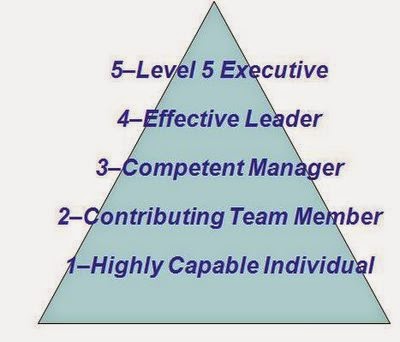
My understanding of a Level 5 Leader is one who is unassuming and ambitious for their organization rather than for themselves.  This contrasts sharply with the character and behavior of leaders we may commonly find at the pinnacle of many organizations - those that present as charismatic and larger than life and are DEFINITELY ambitious, but for their own personal gain.  So should we - or more particularly me - be surprised that these are the leaders I encounter too often and am left uninspired by?  They are geared and driven to get to the top to achieve their personal ends whereas Level 5 Leaders - because they are more ambitious for the success of their organization - are more inclined to sublimate their personal achievements in deference to organizational goals.  In my assessment, they are far more inclined to be humble and self-sacrificing than their more ambitious counterparts and as a result are more likely to be overlooked for leadership roles.

So now here comes my highly controversial and perhaps overreaching insight from a very different source of information.  I recently completed a book authored by Sebastian Haffner in 1978 and translated from it's original German in 1979.  This analysis of a prominent historical figure of our time was entitled "The Meaning of Hitler".

Right off the mark you might now question how I could at all reasonably tie an assessment of Hitler's reign to that of anybody in a leadership role today.  What possible insight could I have gleaned from a book analyzing the actions of a genocidal megalomaniac?  Simply this.  Haffner analyzed both Hitler's successes and achievements and contrasted that against his failures and defeat.  What he concluded from both was that the rise and fall in Hitler's fortune was not as a result of any physical, mental, emotional, intellectual or other change in Hitler himself.  He suggests that Hitler was quite dogmatic and unwavering in pursuit of his ends and the means to achieve those ends.  Rather, Haffner states, "[The] key lies not in any changes in Hitler.  It lies in the change and alternation of the opponents with whom Hitler had to deal."  He goes on to say "Successes always involve two [people] - and the success of one is the failure of the other.  Given constant strength one can be successful against a weaker opponent and unsuccessful against a stronger one...Hitler's successes and failures become instantly explicable if one turns one's attention away from Hitler and towards his opponents at the times in question." (underline is my emphasis).

In short Hitler only succeeded as a leader when he faced weak opposition, when he faced weak leaders - Chamberlain, Daladier, and others within and outside of Germany - in the years leading up to World War II.  After the invasion and subjugation of Poland, and most definitively after 1941 and declarations of war on the Soviet Union and the United States, Hitler faced a decidedly different calibre of leaders in the form of Churchill, De Gaulle, Stalin and Roosevelt.  He ultimately was defeated even though his character and tactics had not changed at all from those that had led to his early, spectacular successes.

This may seem like a somewhat belabored point but the insight I gained from this unlikely source is that mediocre leaders, poor leaders or destructive leaders succeed not so much by what they do but by what we ourselves fail to do.  If we desire different leadership we must have the courage to look for it, to ask for it, demand it and support leaders that will inspire us to some more noble goals and achievements.

If the collective WE fails to exert our own expectations and standards for the type of leadership we desire than we likely deserve the hand we are dealt.  Misery may love company but it's no recipe for success.
______________________________


Greg Hadubiak, MHSA, FACHE, CEC, PCC
Executive Coach/Consultant
BreakPoint Solutions
gregh@breakpoint.solutions
780-250-2543

Helping leaders realize their strengths and enabling organizations to achieve their potential through the application of my leadership experience and coaching skills. I act as a point of leverage for my clients. I AM their Force Multiplier.

Monday, August 18, 2014

Building a Successful Team

Over my 25+ year career as a senior executive, consultant and coach, I've had extensive opportunity to be part of and lead many teams.  I've also had the privilege of assisting others build great teams or navigate the challenges of dysfunctional team environments.  I continue to have opportunities to diagnose and work with teams not performing at their optimal levels and continue to distill lessons from my own leadership experience to impart to them.  In doing so, I've particularly reflected back on what I still consider the best team that I have ever worked with which dates back almost 15 years.

When I first entered the picture as the new CEO of this particular organization it was experiencing more than a bit of stress - the organization itself was relatively new, it was experiencing the effects of significant budget cuts and service reductions, it had relatively poor standing with its public, the board itself was split along a number of different lines, and the past CEO - seemingly well-liked by the management team - had been let go.  Needless to say this wasn't an inviting environment and starting point upon which to commence my new leadership role.  By the end of my tenure though we had earned accolades and awards at a provincial level, had great relationships with our staff and unions, and performed at a level all out of proportion to our size.  We became the benchmark for other organizations like us - and many times our size.  What accounted for that success?  For me it had to be our level of teamwork, key elements of which I will describe below.

One of the first things I did was to take the management team back to ground zero.  Why were we here as an organization and what were we supposed to be focused on delivering?  We didn't have the luxury of building the mission, vision and values of the organization from scratch - the board had already done that to the perceived exclusion of the management team.  So I took them through each element of and, in some cases, each word of these statements and looked to develop better understanding for ourselves as to what worked in guiding our strategic and operational goals and activities.  This "reverse engineering" of our organization's mission, vision and values took time but it was time well spent.  At this point forward the management team owned these directions and goals.  We were all on the same page.

The team also created an environment in which all points of view were afforded an opportunity to be heard AND ACTED UPON.  I believe I led the way in this regard but all team members took probably what for them was significant risk in trusting that this new CEO meant what he said in seeking their input, information and guidance on a variety of initiatives.  I'm sure that for many "traditional" leaders looking in or experiencing some of my team meetings they would have described them as chaotic.  That might have been true, but I do like to think of it as organized chaos and that there was method to my madness.  I believe I was able to demonstrate that the answers to any question and challenge did not come from any one source no matter how authoritative.  The result was that we came to better solutions that everybody then bought into and supported.

Related to this organized chaos, was that this team had good, open communication which sometimes meant that our passions were freely expressed and differences of opinion were on the table.  We didn't agree for the sake of agreeing and we were prepared to challenge each other on a regular basis.  In our team, one was well advised to leave their ego at the door as it wouldn't long survive! We didn't suppress conflict or engage in conflict simply to be difficult.  We engaged in conflict precisely because we were passionate about our shared goals and were committed to being the best we could be as an organization in service of our clients and staff.  In this regard we also respected each other as professionals and for the experience we brought to the table.  We trusted each other.

We also set high expectations for ourselves, our team and each other. This equated to plenty of additional hours and taking on more than one set of duties to see something through.  This was true of all of us - including myself.  We undertook such effort not because it was demanded of us or mandated.  We did so because we were passionate about the work we were doing and we were committed to the team as a whole.  We didn't want to let each other down.  In a similar vein, we also took the time to support each other as needed.  Overall we were a very young team - on average I'm guessing that our management team's average age was 30 - but we did have some "veterans" on our team too.  Regardless, all of us seemed to recognize that we had opportunity to learn and develop and we gave freely of ourselves to others to strengthen them and our overall success.

Finally it is clear that while we worked excessively we did so because we truly enjoyed each others company.  We worked hard and played equally as hard.  Many of us have maintained contact and friendships throughout the intervening years.  I am exceedingly pleased when I do have the chance to meet again with some of my former team that they still describe our time together as the best experience of their career.  Sometimes it seems like that may have just been fortuitous but I also recount how challenged we were at the beginning of our time together.  I know that our success only came from a commitment to common goals, the courage and willingness to challenge each other and the status quo, and a passionate commitment to each other.

I believe a powerful team can be created with these "lessons" in mind.  It takes guidance from a leader to be sure but it also requires courage on the part of the leader to let the team develop its own path.  A strong and powerful team does not develop in the shadow of a leader but rather because a leader has the courage to let the light of the team and its members shine.
  _

Greg Hadubiak, MHSA, FACHE, CEC, PCC
Executive Coach/Consultant
BreakPoint Solutions
gregh@breakpoint.solutions
780-250-2543

Helping leaders realize their strengths and enabling organizations to achieve their potential through the application of my leadership experience and coaching skills. I act as a point of leverage for my clients. I AM their Force Multiplier.

Friday, August 8, 2014

Power...and the Aura of Power

Albertans woke up today to see the latest in what has become the ongoing saga of the demise of our former Premier - "Rules broken, money misspent...Aura of power...Premier used public assets (aircraft) for personal and partisan purposes...Other areas of government were wary of challenging decisions made in the premier's office...".  The latest issue is now being handed over to the RCMP to assess whether  criminal charges are warranted.  As was to be expected, the governing party is taking all steps it can to portray the issues as the actions of an individual while the opposition parties are doing all they can to paint this as simply the most visible sign of a culture of entitlement of a party too long in power and accustomed to doing as it pleases.

Politics is certainly a dirty game and I don't operate under any illusions about the altruistic motives of any of the parties involved in this current (or ongoing) scandal.  Opposition parties sense that their time to make hay is now but I've become highly skeptical and jaded as to whether any politician is better than the next.  Similarly we see political colleagues of the former Premier doing all they can to express outrage at the abuses of political office and public resources.  This kind of retrospective courage seems to me to at best insincere and delusional.  At worst it is self-serving.

I wish that this might be the end of the story but I'm not convinced of that.  Prior to this scenario playing out we had previously seen stories out of the public sector relating to dubious expense claims, large and questionable severance packages or golden parachutes, and other abuses of power.  I believe that there is more to come and more to be uncovered.  The full reality of what exists will not come easily especially in light of how previous leaders have already fared in the court of public opinion.

The reality of leaders who abuse their power - even at the risk of public exposure or worse - continues to exist primarily because some leaders do feel entitled, all powerful and above reproach.  In some cases they may even believe that they are doing nothing wrong, that anything that benefits them somehow benefits all, and even if there are abuses they will never be discovered.  They operate with immeasurable confidence in their own superiority and are not reluctant to use fear and intimidation as weapons to build, sustain and grow their personal position.

More troubling though is that WE allow and facilitate this type of leadership.  Our former Premier and other leaders who have been turned out of the public service for similar alleged transgressions did not accomplish all they did on their own.  And make no mistake, this kind of leadership behavior is not isolated to the public sector.  Leaders - both good and bad - work with and through others.  Salaries ultimately have to be approved by someone, airplane manifests processed by others, expense claims submitted and managed, and so on.  Many of us might try to find some solace or comfort to say that WE were intimidated by our leader, that we feared for our jobs or careers, or that "we were just following orders".  Some of us may have even developed a misplaced sense of loyalty and confused that what was good for the leader was similarly good for the organization.

Worse is that we may have been co-opted by a flawed or narcissistic leader.  For those serving a political master they may have seen their political future tied to the rising star of another.  Maybe they hoped to gain a new or more prominent cabinet posting.  Others see loyalty as key to their leadership aspirations down the road.  And sometimes they believe that it is best to protect their leader for the sake of their party's standing and reputation.  Parallels in our own organizations certainly exist.  Our job satisfaction, salary, bonuses, enhanced benefits, and other perks can be used to build a sense of commitment to a flawed path.  WE are a multimillion or multibillion dollar organization.  There is great pressure and responsibility that comes to me as a leader.  What's wrong with a few extra hundred, thousand - or hundreds of thousands - dollars coming my way?

This doesn't happen overnight.  Rather it very much mirrors the iconic story of a frog slowly being boiled to death.  Slowly but surely we compromise our values and high ideals because no one step or decision seems critical or egregious enough to cause us to stand up for what we say we believe in.  One day we just wake up and know that we are well past the line we vowed never to cross - or maybe we now find ourselves having to deal with uncomfortable stories on the front page of our local newspapers.  Whether as governing boards, as peers, or colleagues there are ample opportunities for us to exercise oversight, fulfill assigned duties, ask questions, or find the courage to say no.

WE often don't lack for proper policies, procedures, processes and protocols to hold ourselves to high ethical, professional and organizational standards.  More often WE lack the courage to use those tools and to hold to our values.  More often WE are not prepared to pay the price or endure the pain that comes from exercising that courage.

I recently finished reading a biography of Dietrich Bonhoeffer (author - Eric Metaxas).  It details the life of this German pastor, theologian, and author with a particular focus on his struggle against Hitler and Nazi Germany.  This is not a simple tale of right and wrong as it could easily have been turned into.  Bonhoeffer's struggles in finding his path are well documented by the author, and in the words of Bonhoeffer himself, as he determined what was right versus what was perceived as correct and loyal behavior for a German leading up to and through World War II.  He often fought with and was reviled by his peers.  He progressively lost his ability to practice as a pastor, to teach and to write.  Regardless he held true to his values and exercised choice in how he would live and lead.  His choice to not compromise his belief as to what was right for Germany and the Christian community ultimately resulted in his execution mere days before the end of World War II.

I'm not suggesting WE have to die for what we believe in.  What I am suggesting is that WE have far less at stake in holding ourselves and our leaders accountable than a Bonhoeffer, that WE have far more choice to do so than WE would like to believe, and WE have opportunity - and examples to guide us - in finding the courage to enforce a standard of leadership that WE deserve.

Be clear on your values, exercise your leadership, and make a difference because of it.
.

Greg Hadubiak, MHSA, FACHE, CEC, PCC
Executive Coach/Consultant
BreakPoint Solutions
gregh@breakpoint.solutions
780-250-2543

Helping leaders realize their strengths and enabling organizations to achieve their potential through the application of my leadership experience and coaching skills. I act as a point of leverage for my clients. I AM their Force Multiplier.

Thursday, July 24, 2014

Are you really listening?

Executive Coaches like myself often take pride on coming up with a great question that really touches on a crucial aspect of an issue that our client is presenting to us.  Moreover, we strive to engage in a coaching conversation, using questions as our tools, to get to the heart of the issue that the client is not presenting to us or even hiding from themselves.  What may be overlooked in this regard is that the ability to intently, actively and consciously listen to what our client is saying is critically important to knowing when to ask the right question.  Only by intense listening can we be of true service to our clients and help them discover, develop and own their personal action plan.

There are similar lessons for leadership in this coach-approach to interacting with and building your teams and in getting the best results for your organization.  In today's cacophonous and demanding environment leaders can easily lose the power of effective listening.  We are constantly being bombarded by "noise" from all angles and even in our off-time we seldom disconnect from our business - checking e-mails, answering calls, and just trying to catch up with our just "finished" work day while we get ready for the sprint tomorrow.  Sure, we might make the pretense of listening to the feedback and input of others but how often have we caught ourselves multitasking while one of our peers or subordinates is speaking to us?  How often do you catch yourself scanning your e-mail or sending a text message while on the phone?  What did you really take away from that conversation?

As leaders we are impatient for action.  We feel the need to be decisive.  We rarely take the time to pause, focus and reflect.  And that often means we have little or no time to listen for critical facts or observations coming to us from the skilled staff we have surrounded ourselves with.  We have lost the ability to discern what's important from the multitude of inputs coming at us.

Our own survival mechanisms also do us no favors.  Sometimes, in order to maintain the pace we have set for ourselves we subconsciously establish an array of filters that are intended to make us more "efficient" but actually compromise our ability to see the "forest for the trees".  So before we have had the chance to evaluate information coming our way our mind has already reacted instinctually, discounted the new data on the basis of the individual speaking (e.g. that staff member is too low on the totem pole to have relevant information), context (e.g., "they" don't know enough about our business to comment), or something as simple as timing confounds us (e.g., our minds are focused on another problem that seems more pressing at the time).

Organizations are similarly at risk of omissions in listening.  We engage in strategic planning exercises, employee engagement surveys, stakeholder focus groups, and opinion polls but sometimes structure the questions or processes to get the answers we want.  More astounding is that we sometimes lack the discipline to truly hear what our constituents are telling us even when it comes out in black and white.  We can easily hear what we want to hear and look for input that reinforces our existing biases.

So at an individual leadership level how can you overcome this bias against effective listening?  Here are some suggestions:
  • Disconnect from work/technology with a conscious intent.  Each of us needs some down time or reflective time.   We all need time to truly catch our breath, dedicated time to assess demands on our time, and clearly establish priorities in our business day.  It takes a huge amount of personal discipline to not just jump back on the treadmill at the crack of dawn every day.
  • Find your personal way to gain or conserve energy.  You will simply not be an effective listener if you are not rested and/or energized.  Each of us will have a different way of capturing this energy from getting one more hours of sleep, to sticking to a fitness schedule, to keeping up with a personal hobby or interest.  Give your body and mind a rest or a change of pace.
  • Step back and truly focus on the person in front of you.  Don't show up at a meeting or invite someone to talk to you without the conscious intent of actually listening.  Take at least five minutes to actually prepare yourself for your next meeting or conversation.  Put your last call, meeting, e-mail, whatever out of your mind before moving on to the next session.
  • Show up with a curious and humble mind.  Be prepared to ask questions.  You DON'T have all the answers.  If you did you'd be running the show all on your own.  If you are running an organization of any size there are far more things going on then you have eyes or ears to keep abreast of.  Respect the insight, experience and capacity of those you work with.
  • Don't interrupt.  Hold yourself back from having to have the answer.  Resist the temptation to formulate a response, rationalize a strategy, or otherwise be the expert.  Yes you are a leader and you may have come to expect that you should be decisive, but you should even more so consider yourself a facilitator with a mandate of pulling out every piece of information you can from all around you.  
Listening - effective listening - may seem like a lost art and perhaps it is.  But it's an essential leadership skill in this complex and ever changing world of ours that will likely require every ounce of discipline you have.  To listen is to lead and listening will set you apart as a leader.

  ______________________________

Greg Hadubiak, MHSA, FACHE, CEC, PCC
TEC Canada Chair/Executive Coach/Senior Consultant
hadubiak@wmc.ca

Helping leaders realize their strengths and enabling organizations to achieve their potential through the application of my leadership experience and coaching skills. I act as a point of leverage for my clients. I AM their Force Multiplier.


Thursday, July 17, 2014

One small step for man...many lessons in success

Time to get my geek on again.  For those of you who have read my blog for a while you'll have noted some references to Star Trek and Captain Picard.  Well those references only belie a much broader interest in astronomy and space exploration.  So it's with more than passing interest that I'm thinking about this coming Sunday, July 20, which marks the 45th anniversary of the first manned landing on the moon.  At the time I was only three and a half years old but yet I remember sitting in front of the TV with my parents, looking at the grainy pictures from a world away, and setting off a fascination with space that has lasted to this day.

Obviously this was a great achievement in human history.  What we may tend to forget, particularly as we get more distant from the event, was that this success was never assured nor was it achieved without great effort and sacrifice.  I believe that the success of the US space program in the 60's and 70's has a lot to teach us about achieving success in our business ventures today.

First, it is informative to remember that the genesis of the mission to land humans on the moon in many ways came out of a singular defeat suffered by the US in the late 50's - the successful launch by Communist Russia of a satellite (Sputnik) into Earth orbit in 1957.  This defeat - coupled with the fear of being outpaced by the rival Soviets - was compounded by other "firsts" of the Soviet space program, most notably getting the first man into space in 1961.  This "defeat" spurred on US efforts to get back in to the space race, redouble its efforts and ultimately establish a vision to inspire and guide their space program in the 1960's.  

“I believe that this nation should commit itself to achieving the goal,
before this decade is out, of landing a man on the moon
and returning him safely to the earth.”

President John F. Kennedy
What followed was a series of smaller steps before the ultimate success of Apollo 11.  From 1959 to 1963, six one-man flights of the Mercury program started the American manned space program.  This was followed by ten two-man flights of the Gemini program concluding in 1966.  The US took a series of small steps, increasing in complexity from the first Mercury flight through to the end of Gemini to set the stage for the Apollo missions.  Yet, despite all that had been learned over 16 previous efforts and years of work, the first Apollo mission ended in the tragic deaths of the entire Apollo 1 crew during a pre-launch test.  Lessons had been learned, the vision was compelling, smaller successes had been enjoyed, but trials and tribulations still had to be overcome.

Four manned Apollo mission preceded Apollo 11.  Again each of these missions kept moving the needle forward until such time as all was believed to be in order to attempt a landing - and departure - from the Moon.  Even at this late stage preparations were made for failure.  Then President Richard Nixon was provided with the text of a contingency speech, one that Nixon would read if tragedy struck and Neil Armstrong and Buzz Aldrin were left stranded on the lunar surface forever.

 Fate has ordained that the men who went to the moon to explore in peace will stay 
on the moon to rest in peace.  These brave men, Neil Armstrong and Edwin Aldrin, know that there is no hope for their recovery.  But they also know that there is hope for mankind 
in their sacrifice...

And there was a reasonable expectation of failure or at least no guarantee of success.  The risks were understood and at all levels of the effort - from the President down to the individual astronauts - there was a tolerance for that risk based on the compelling vision and the rewards expected for success.  
Ultimately, even with the singular success of Apollo 11 and a bit of complacency that comes with such a triumph, fate intervened to let us know that success is never assured or final.  In the case of manned space flight we were reminded of that relatively quickly with the near fatal accident of Apollo 13 and since with tragedies that have befallen the Space Shuttle program.

So what parallels in the success of Apollo 11 are to be seen in looking at what it takes to succeed in our more terrestrial ventures?  Here's what I believe we can learn from this 45th anniversary of Apollo 11:

  1. We can be motivated by defeats and even fear to set out on a path to success. 
  2. Don't underestimate the power of a compelling vision that stretches what you think is possible.
  3. Don't discount the small steps along the way that are necessary to achieve something truly great.  
  4. Reaching the pinnacle of achievement doesn't happen overnight nor without significant effort.  
  5. Plan for the best but prepare for the worst.  
  6. Success is never assured and it is more than likely that we will experience trials, challenges and adversity before we achieve our ultimate goal.  
  7. There is risk to be managed - and tolerated - in achieving something truly great.  Nothing risked, nothing gained.  
  8. Just as the Apollo program led to significant advancements in avionics, telecommunications, and computers, be open to other opportunities along your path.
  9. Never become complacent.  Just when we think we are on top of the world or have our plans and processes aced, something comes along to remind us of the need for humility, diligence and what it took to get to the top.
Look to the moon this weekend and be inspired by an achievement now 45 years old.  May you be so bold.
______________________________

Greg Hadubiak, MHSA, FACHE, CEC, PCC
TEC Canada Chair/Executive Coach/Senior Consultant
hadubiak@wmc.ca

Helping leaders realize their strengths and enabling organizations to achieve their potential through the application of my leadership experience and coaching skills. I act as a point of leverage for my clients. I AM their Force Multiplier.


Tuesday, July 15, 2014

The personal side of change management

I've done a lot of work in the area of change management.  This has been true on a one-on-one level as an executive coach, as a consultant working with a team or a business, and as a leader of various organizations over time.  I've been schooled on various models, best practices and pitfalls of change management.  In recent months, I've also found myself facilitating team sessions and running workshops around change management.  However, it wasn't until I read a blog post from another author that I gave much thought to the true personal impact of change despite the fact that I've worked through a pretty major change in my professional life in the past couple of years.

The blog post I recently read took a hypothetical look at the impact of change and crafted the story of an executive trying to explain to his young daughter why daddy was spending more time at home.  It was a nice work of fiction and covered off some of the questions that a child might ask of a father or mother in those circumstances - Why are you home so early?  What are you going to do now?  Does this mean that we won't go on vacation this year?  Will we still see our friends from work?

The post got me thinking about - and reflecting on - my own experience with the drastic change in career I took just over 2 years ago, what it meant to me at the time and since, and the power of that story to perhaps help others.  This latter point keeps coming home to me as I work with a variety of individuals and organizations as they initiate or react to change where we can overlook - quite consciously sometimes - the very real cost of change on a personal level.

In my case I saw the "writing on the wall" several months ahead of my eventual departure from my leadership role.  My organization undertook a long drawn out management restructuring that saw some leaders reappointed without competitive process while others were required to go through a selection process.  Early on I gave my direct reports the heads up that this was likely a convenient way to "reintroduce me to the marketplace".  Despite this foreshadowing on my part I continued to put forth best effort into my work and into the selection process as well.  However, coming to a reasoned assessment as to my ultimate fate did nothing to reduce my stress and anxiety during this time.  After all I had given a lot of my self into my organization in the preceding ten years and in many ways my role had become my identity. In actual fact, I had to deal with a string of sleepless nights leading up to my final interview with the assistance of a bottle of red wine.  As somebody who could be rightly called a teetotaler this was a helpful sleep aide.

I have to say that the actual "departure" event was relatively anti-climactic.  At some levels it was actually quite the relief to no longer live the charade of the past several months.  The surprise and shock was experienced more by my direct team than myself.  While I have not analyzed my "terminal event" through the lens of the Kubler-Ross model on death and dying, I probably did proceed through denial right off the bat if only manifested in a decision to take my family on a Disney cruise within a week of leaving my former executive role.  I'm still not sure how to truly assess that vacation time - was it an act of defiance, an act of reassurance for me, an act of reassurance for my family, or all of the above?

I've not had the same fictional experience of my daughters asking me why I might have been home more in the early days of my transition, or whether we were going to have a vacation or be able to buy them a new toy.  Rather it was me spending another string of sleepless nights trying to answer those types of questions for myself and trying to hold true to my own self-image as "man-of-the-house", professional and provider.  On and off over the past couple of years I've found myself having those same self-talks and striving with all my might to make sure that there is no impact to my family, their lifestyle and their goals.

I'll say that it's a lot to hold together and despite the best efforts of others - my wife in particular - it's a burden that I often still choose to shoulder alone.  I've not been able to completely answer all of my own questions over those past two years (e.g., where did some of my "friends" go?) but for the most part I've effectively dealt with the impact of organizational restructuring on my personal and professional life.  I remain anxious and carry the silent burden of trying to keep my family in the lifestyle they've become accustomed to.  I've remained committed to ensuring that my wife and daughters still get to experience all they can from life.  Overall, I believe I have held true to what's important to me as well as a leader and have translated that focus from a senior leadership role to one of business coach and consultant.

So what might be the power or lessons of this story for you in your leadership journey?  I hope there are at least two things that you might take away from this.  First, despite all the trials and tribulations we may be subjected to in our personal and professional lives, if we maintain our focus, effort and vision we can actually turn challenge into success.  So the sun does rise again.  Second, if you are initiating change, make effort to look beneath the project charters, timelines, and metrics to see the people being impacted by the change.  Recognize the extraordinary power you hold over their lives at that moment and into the future.  Recognize, appreciate and truly manage the personal side of change.
______________________________

Greg Hadubiak, MHSA, FACHE, CEC, PCC
TEC Canada Chair/Executive Coach/Senior Consultant
hadubiak@wmc.ca

Helping leaders realize their strengths and enabling organizations to achieve their potential through the application of my leadership experience and coaching skills. I act as a point of leverage for my clients. I AM their Force Multiplier.

Monday, July 7, 2014

Give your Willpower a fighting chance!

One of the things that I've really come to appreciate since starting up my coaching/consulting practice is the value of structure in my work - and personal - life.  It's not that I didn't have structure in my former executive role.  Lord no!  In fact, in my former executive world I was somewhat inundated with structures and other people who helped me with their own structure or imposed it on me!

However, as I have reinvented myself as an Executive Coach, TEC Canada Chair and consultant, I've had to become much more self-reliant on my own personal efforts.  I no longer have an admin assistant, an executive associate or a team to keep me on task.  I can no longer rely on others to remind me of upcoming meetings, set me up with briefs or notes from the past, or otherwise keep me progressing forward.  What I've also come to realize is that all my best intentions, willpower, and (fading) memory are "tools" that are inadequate to keep me on track and, more importantly, ahead of and on top of my timelines and goals.

What I've discovered is that many if not all of my clients suffer from a similar misplaced faith in the power of their own self-discipline and motivation.  It's clear that all of us suffer from some form of self-delusion in this regard.  We see ourselves as highly competent and motivated professionals, executives and leaders and, therefore, expect that we should be quite able to keep ourselves and our organizations on track through the sheer force of our indomitable will and strength of character.  When we fail to meet these high expectations for ourselves our level of frustration, anxiety, and even self-loathing is something to behold.  This is despite the fact that in many cases we have set ourselves up for failure.

But there is a way out of this trap and a way for us to actually better establish the basis for ongoing success in our lives.  It's all about structure.  And I'm not talking about overly complicated, burdensome and bureaucratic things that we might all dread.  It's about taking simple steps in our day-to-day lives that can give our willpower and good intentions a fighting chance to succeed.

So what kinds of things have I done to help me become successful and hopefully more successful into the future?  One of the first and best things I have done over the past 2 years is in fact create my own one page business plan.  That may sound intimidating to most of us and but I can tell you from personal experience that it helped focus my mind and efforts at the beginning of my journey and, more importantly, has served as a great touchstone to evaluate my ongoing efforts and success on a go-forward basis.  The key here is to SCHEDULE some time in your calendar to complete this task and then to review it on a regular basis - not less than every quarter.

Second, use the power of your electronic calendar and access that most of us have to personal digital assistants.  Given the number of clients that I have to personally navigate each week it is critical for me to not only establish my schedule of upcoming meetings in my calendar but also to set reminders a week or month in advance of critical dates and deliverables.  I try to ensure I am ready for each client encounter before it happens and if I tried to rely solely on my memory...well, I'd be out of business pretty quickly.

In similar fashion, I use my calendar and reminder functions to ensure that I do advance follow-ups with all of my clients once per week on a set schedule.  For me that has become Friday mornings, where I have set a time to connect with my clients, remind them of their commitments, and help them show up our meeting ready to work.  I have become part of their structural support network.  I also encourage them to follow-up with me - in particular as a result of coaching sessions - with their declared personal commitments immediately following our work together. 

For those of us with an ongoing support network - admin assistants, secretaries, executive associates - I also recommend enlisting those people as key supports.  If you lack structure, give permission to these staff to "impose" structure on you.  They are there to help you if you will only let them.  Often times you are much more desirous of being in creative and entrepreneurial mode while these people really do have a greater love for structure and order than you do.  Let them complement your best leadership qualities with what they know and do best.

I also personally use - and recommend to my clients - that they make use of some very ancient and useful tools at their disposal.  Sticky notes and paper.  Get things out of your head, on to paper, and visible to yourself on an ongoing basis.  As you create your personal business plan, get it out of your head and your computer hard drive, print it out, and paste it on your wall and in your line of sight.  Let it serve as a constant reminder of your personal and professional goals and objectives.  Let your visible and written plan guide your daily actions.  Similarly if you are having trouble overcoming a bad habit (e.g., checking your e-mail first thing when you come into the office, checking voice-mail) then put a bright colored sticky on your computer/phone to remind you to focus on your priorities first - what actions are going to help you move forward on your business plan objectives. 

We are all well-intentioned and capable professionals and leaders.  We would not have risen to our current status and roles if we were not.  But by applying a little more structure to our good intentions and willpower we can make that success easier to obtain and sustain.  We can give ourselves a fighting chance to become even better leaders.
______________________________

Greg Hadubiak, MHSA, FACHE, CEC, PCC
TEC Canada Chair/Executive Coach/Senior Consultant
hadubiak@wmc.ca

Helping leaders realize their strengths and enabling organizations to achieve their potential through the application of my leadership experience and coaching skills. I act as a point of leverage for my clients. I AM their Force Multiplier.


Monday, June 30, 2014

Failure is an option

In the past two years as I've continued the transition from senior executive leader to executive coach/consultant I've been struck by how many of my colleagues have commented on their perception of my successful reinvention.  On many occasions I've been asked for the secret formula to help others achieve their goals and objectives.  In truth, it's hard to imagine that over two years have passed since I first left behind my 25-year career in health care.  A lot has happened since then and while there has been success there has also been failure - and fear of failure - along the way.  In fact, I believe I have learned more about myself as a result of my setbacks then I have from my moments of achievement.

Sitting down to pen this blog entry, I actually decided to focus in on an initiative that I have been actively engaged in for about a year now.  Taking stock of my current status and efforts to date in this year-long process could readily bring me to the conclusion that I am actively failing in this particular aspect of my practice.  Truth be told, it may only be a matter of time before I or someone else determines that the investment of time and effort is no longer worth it.


So what have I learned from this laborious journey?  In no particular order, here are my lessons that I hope resonate with you and that may help you appreciate that failure can be an option in establishing the basis for ultimate success:

One:  Anything worth doing will take effort, time, and sacrifice.  If it were easy then everybody would be doing it.  If I've picked up anything from the time and effort I've invested in this particular venture it is that success is by no means guaranteed and just when you think that you've turned the corner or have the commitment of others to your cause...well, don't count your chickens before they are hatched.  These setbacks have to be used to your advantage - take a hard look at whether you evaluated the situation correctly, hone your tactics, and try again.

Two:  Act Fast and Act Smart.  Somewhat contradictory, but the fear of failure and rejection held me back when I first started down the path for this particular initiative.  It pushed me out of my comfort zone where by nature I'm quite the introvert.  Templates did exist to support action and my take away from the past year is to simply face one's fears and fail faster.  By failing I've been able to adjust my methods to better suit me and my clients.

Three:  Don't become paralyzed.  As a corollary to point Two above, I've come to the conclusion that is better to move and fail then to sit in fear of movement and potential failure.  From an executive coach standpoint its interesting for me to note that this is often the perspective that I'm working with my clients on.  If you don't apply for the job you are guaranteed not to get it.  If you don't take the risk you are guaranteed not to succeed.   What is the true risk of failure versus the true risk of not trying at all?

Four:  It's not all about you.  Or your product. Just because you have something to offer which you really believe in, see as meeting a major need in your market, or simply believe can't miss still doesn't mean that you don't have a whole lot of leg work to do.  In may case, it probably took me several months at the beginning of this particular initiative to "buy-in" so why did I expect it would be any different for my prospective clients?

Five:  Be prepared to change.  Being stubborn and failing to adjust your methods or tactics in the face of setbacks is nonsensical.    As Albert Einstein is quoted as saying, the definition of insanity is doing the same thing over and over again and expecting different results.  If the end goal is important - and it is to me - be open to advice and your own learning to try something different that will change the quality and speed of our your outcome.

Six:  No isn't the end.  Perhaps too many of us - and certainly myself - strive to be perfectly successful all of the time.  A "NO" is often accorded weight out of all proportion to the "YES" we get.  No can mean any number of things from "not right now" to "it's the wrong fit".  And sometimes getting those No's can be quite beneficial to the quality of our initiative in the long-term.  Put your NO's in proper context.

Seven:  Work with the right supports.  In the past year I can clearly identify those that have been hugely positive and constructive supports on my journey.  These individuals have not just been cheerleaders.  On the contrary.  In many circumstances they have been a necessary catalyst to positive and forceful action on my part.  To put it less euphemistically they have kicked my ass when I needed it.  In contrast, I can just as easily identify those that have either been actively working against me or have been providing less than constructive ideas along the way.  In some cases, this is despite us ostensibly being on the same "team".  Nothing worth doing can be done alone or in the absence of the right team in your corner.

Eight:  Doing everything perfectly may not yield your desired result.  I love the Captain Picard quote in this image.  It brings us back to reality and helps us appreciate that a variety of circumstances - and even luck - may confound our best efforts and a perfectly executed plan.  Your choice at this point is to assess, analyze, learn and apply the lessons to the next opportunity.

Overall, even if I finally and officially "fail" in my particular endeavor I know that I have come away with a lot more tools at my disposal than when I started.  The experience, abilities, insights and skills obtained have already benefited me personally and professionally.  I have built up new networks, pushed myself out of my comfort zone (with more work to do), and ultimately I bring greater value to my colleagues and clients into the future.  When approached with maturity and patience with self, our failures can be far more instructive than our successes ever can be.

Failure is an option if you can learn, adapt, persist and grow.  Leadership isn't just about an unending string of successes.  Leadership is about breaking new ground.  Failing at the endeavour might be overwhelming and a bit frightening but that's what leadership is all about.
______________________________

Greg Hadubiak, MHSA, FACHE, CEC, PCC
TEC Canada Chair/Executive Coach/Senior Consultant
hadubiak@wmc.ca

Helping leaders realize their strengths and enabling organizations to achieve their potential through the application of my leadership experience and coaching skills. I act as a point of leverage for my clients. I AM their Force Multiplier.


Friday, June 20, 2014

Resilient Leader - Resilient Organization

In recent months I seem to be talking to a lot of people about change, how to manage change and how to keep sane while doing so.  Moreover, leaders have expressed to me the challenge of staying optimistic in the face of daunting or seemingly never-ending change in service of those they lead.  How can they "provide lift" to their staff as opposed to being one more "source of drift" in a sea of turmoil?

We are all challenged by change - even changes that we make voluntarily (e.g, marriage, becoming a parent, taking a promotion, doing an Ironman!). And there is good reason to by anxious about change.  We don't really know what the future will bring.  We don't know for certain if the skills, experiences and abilities we have acquired will be sufficient to succeed in the face of new challenges.  In many circumstances, we have invested so much time, energy and emotion into our current roles that our positions and titles have become our identities.  Having to change means abandoning who I perceive or believe that I am.

It's not just big change that brings us down either.  Even small changes - added together - can ultimately wear us down and lead to despair.  The final poke becomes the straw that breaks the camel's back - a sleepless night; a computer glitch; a client, boss or co-worker changing a work deadline.  Any one thing in and of itself may not be too daunting.  Keep adding it up and we start to fatigue.  We are no longer resilient.  No longer able to respond - and lead - effectively.

But yet there are those around us that seem to bounce back with greater vigor from truly catastrophic personal and professional setbacks.  We find ourselves amazed by these stories of triumph over tragedy.  In most cases, we also attribute success to the miraculous and singular capacity of these individuals to overcome these challenges.  We discount our own ability to be just as resilient in the face of the odds.  We diminish our ability to develop and grow our capacity to be resilient.  But there are ways and means to become more resilient as individuals and as leaders.

Ironically enough, one of the best things you can do to maintain and build your resiliency, your energy and capacity to manage change, is to first take care of yourself.  While there is some sort of perverse culture that too many of us subscribe to that turns leadership into a test of stamina, the reality is that without proper self-care our leadership capability is diminished with fatigue.  As a leader consider yourself an elite athlete.  An elite athlete may train extensively, but they also match that regimen to proper nutrition and rest.  Moreover, they prepare for their major competitive events by reducing the volume of training in advance of a big race - and also take time for recovery after a major effort.  To be an effective leader you need to follow a similar pattern.

No person is an island.  Being an effective leader also requires recognition that it can indeed be lonely "at the top" of whatever work unit you are in - from CEO to front-line manager.  You will need support on an ongoing basis to work through the various issues coming at you, a sounding board to vent or think out loud, and even somebody to celebrate your successes with.  Ensure that you stay connected with key supports in and beyond your work environment.  Maybe this takes the form of a confidential peer advisory forum (e.g., TEC Canada) or a mentor but there is no upside - and a lot of downside - in being the lone wolf leader.

Remind yourself of your strengths, capabilities and past successes.  None of us who have reached a leadership position have done so by accident.  We have successfully overcome barriers, challenges and dark times before.  There is every reason to expect that we will be similarly successful now and into the future.  We may be somewhat miffed that we have to climb another hill but we do have a track record of success that should give us confidence that we can do it again.  But we have to take the time to reflect on this history of success and build on it to address the new challenge.

Take control.  I truly believe that each of us does have the ability to prioritize our work, control the pace of what is coming at us, and even say no to various demands being placed on us.  The best way and maybe the only truly effective way to gain this kind of control is to again take the time to understand what is of greatest importance to us.  Understanding, articulating and writing down the values we want to live and work by gives us the power to prioritize.  We have the power to choose.  We need only exercise it.

Finally, and related to the last point, live and work with your fundamental purpose in mind.  Be clear about why you work.  What are your fundamental goals?  At the same time appreciate that, just like a river meandering inevitably to the sea, that there are going to be boulders, barriers, rough water and other diversions in your path.  Regardless, you will eventually reach your goal and all the more so if you keep your head up and your eyes focused on the distant horizon.  If your purpose and goal is big enough and important enough there is not much that will deter you from reaching your journey's end.  Moreover it will give you the energy to return to your true course when encountering the next barrier.  It will give you the energy, capacity and resilience to lead in the way that you want to lead.

______________________________

Greg Hadubiak, MHSA, FACHE, CEC, PCC
TEC Canada Chair/Executive Coach/Senior Consultant
hadubiak@wmc.ca

Helping leaders realize their strengths and enabling organizations to achieve their potential through the application of my leadership experience and coaching skills. I act as a point of leverage for my clients. I AM their Force Multiplier.


Friday, June 13, 2014

The Power to Choose Every Day

In my last post - "What kind of Leaders are we REALLY looking for?" - I posed a few burning questions somewhat in service of getting answers for myself but also to spark some conversation amongst my readers.  To sum up, my questions really boiled down to why we continue to be plagued by less than stellar leaders when we really do see some exemplars out there and collectively yearn for an organizational culture that we could all grow and thrive in.

I got a few interesting comments back, some salient pieces of advice on how to continue my search for answers, and some thoughts that sparked even further internal debate.  At the same time that this dialogue was going on I was also working with a number of my coaching clients who are in the midst of leaving their current organizations behind.  Each has given up hope that their organizations can live up to their publicly stated values and their public organizational persona.  They feel stifled, unrecognized, frustrated and quite frankly abused.  Even if they haven't left just yet it's clear that their particular organizations have already lost their full attention and commitment.  These energetic, dynamic, innovative, creative and inspiring leaders have been lost.

That's a sad commentary on organizational culture all on its own.  What makes these stories even more astounding is that the organizations in question are either blissfully unaware of what they stand to lose or, in fact, have consciously driven out the kind of leadership they so desperately need to succeed.  In some cases they have already been presented with clear warning signs - including previous resignations, higher rates of absenteeism, greater degree of conflict, and more customer complaints.  But rather than dig deep into cause or otherwise heed the warning signs the organization has chosen to ignore reality.  They have chosen to stick with mediocre leaders and maintain a draining culture.

Another comment that came back to me was from somebody who was obviously - and sincerely - struck by the willingness and readiness of some leaders to make some pretty hard decisions in service of their staff.  More particularly, what impressed this individual was the willingness and ability of a President/CEO to voluntarily take unpaid time off, setting an example for an entire company, so that layoffs could be avoided.  My reader lamented about something similar not being in their power to effect in their own organization - that the ability to "share the pain" on a proportionate basis was impaired by structures and systems (e.g., human resources policy, finance department regulation, political directives) that actively prevented more altruistic approaches to business challenges.

The irony of the conversation was that these comments were not made by a front-line manager, or a Director or an Executive Director.  The comments and lamentation came from a C-Suite executive.  A person with senior level experience and with broad accountability and authority.  Somebody in a position of power.  I interpreted their comments to mean that they felt and believe themselves powerless in their organization to do something they felt was right and better for staff - because the "systems of the organization" wouldn't allow it.

Now I'm not going to sit here all high and mighty, feigning near sainthood for myself.  After this conversation I could immediately reflect upon more than a few instances where I shied away from some battles over "doing the right thing" gave way to either expediency or a higher power, where I allowed myself to be steamrolled or intimidated.  However, it doesn't change the reality that other leaders have chosen to use their power to the benefit of a higher good or purpose.  Those leaders could also have rationalized another less optimal choice on the basis of contrary directives or recommendations from their shareholders, board of directors, or other factors.  But they didn't.  They exercised their power of choice.  They exercised their leadership power in congruence with their personal values and perhaps of the values of their organization.

As leaders - at every level of our organizations - I believe we consistently overestimate the power of "systems" and other leaders while consistently underestimating our own ability to make decisions and make a difference.  Still don't believe me?  How often do we see examples of leaders in the news who have clearly taken advantage of systems and their power to advance their own personal well-being?   How often do we see bonuses for senior leaders in the same year that staff layoffs impact hundreds if not thousands of others in the same company?


It is clear that leaders have the power to do what they want in many circumstances.  They have the power to make the hard decisions or take the easy way out.  They can choose to lead for the benefit of themselves or for the benefit of the entire organization.

Leaders have the power to choose every single day.  So do you.  

 Every man builds his world in his own image.  He has the power to choose, but no power to escape the necessity of choice.

Ayn Rand  
______________________________

Greg Hadubiak, MHSA, FACHE, CEC, PCC
TEC Canada Chair/Executive Coach/Senior Consultant
hadubiak@wmc.ca

Helping leaders realize their strengths and enabling organizations to achieve their potential through the application of my leadership experience and coaching skills. I act as a point of leverage for my clients. I AM their Force Multiplier.


Monday, June 2, 2014

What kind of Leaders are we REALLY looking for?

Scan the job adverts in any major newspaper or postings being supported through an executive search firm and you are liable to find one or more President, Chief Executive Officer or senior level roles up for grabs.  Most of the postings describe desirable characteristics of the leaders being sought and the values, culture, and/or history of the firm seeking its next leader.

The posting might look something like:

The Opportunity:  The successful candidate must be able to inspire others to achieve their personal goals, establish an organizational vision that ultimately ensures personal success above all else, and establishes an environment in which the team complies with direction out of fear of their jobs and careers.

  Our next leader will:
  • Primarily focus on self and not waste valuable time focused on sustaining others and/or building organizational capacity;
  • Not spend time coaching, mentoring or encouraging others when executive time is better spent getting business-related results that directly relate to ability to generate a personal bonus;
  • Focus on relationships that will enhance their personal network thus facilitating personal advantage both in the short and long-term;
  • Understands that glitzy public relations campaigns, slogans and emotional appeals can often outweigh the effort and cost of more fundamental business efforts;
  • Engage with stakeholders primarily to foster an image of inclusion but otherwise manage expectations to the benefit of self;
  • Have a proven track record of negotiating best possible salary, benefits, and bonuses package for self while effectively communicating need for fiscal restraint for the rest of the organization; and
  • Discourages a culture of openness, inquiry, and debate. 

At this point I'm hoping you are saying "What the heck is this guy talking about?  I've never seen an executive posting like that!!"  And of course you are absolutely correct.  What I have given you is pretty much the mirror opposite of this fictitious posting.  Most of us - and the organizations we work for - would state a desire to have inspiring, visionary, inclusionary, collaborative, selfless leaders.  Yet, to my mind, many organizations, boards, and other executives have a horrible track record of not hiring the kind of leaders they say they are looking for.  I was reminded of this reality when viewing a recent Simon Sinek TED Talk entitled "Why Good Leaders Make You Feel Safe", the link to which is noted here:


http://www.ted.com/talks/simon_sinek_why_good_leaders_make_you_feel_safe

If you have not yet seen this talk I suggest that it is 12 minutes of your time well spent.  There we so many aspects of this presentation that hit home for me.  His first point of reference was a military scenario that led him to wonder whether the leaders he had observed had just been born better people.  He rapidly corrects himself though and suggests that it's the environment that permits these leaders to be created - if you get the environment right he suggests that every one of us had the capacity to do remarkable things.  He goes on to state that the basis for this leadership incubator is an environment built on trust and cooperation.  And you can't tell somebody to trust you or to cooperate with you.  There are no valid "directions" or "speech" by which you can enforce or establish that kind of environment in an instant.  Yet over and over again in my experience I have encountered leaders who believe that by position and authority alone that they should expect the trust and cooperation of others.  Do as I say (not as I do) without question.

Sinek contrasts this command and control environment - and the fear that it engenders - with some remarkable examples of what I consider to be extraordinary leaders.  One such company that he talks about is Next Jump who's CEO, Charlie Kim, instituted a policy of LIFETIME EMPLOYMENT.  This is not in the traditional or historical sense that you and I might understand - or perhaps as our parents and grandparents might have experienced it.  Rather, Next Jump makes the commitment to each employee that they will not be fired - even if you are having performance issues!  Further, they will invest in you, with coaching, training and any other support that helps you stay a part of the Next Jump family.  How many leaders and organizations have you experienced that would go to those lengths versus terminating for cause or not and hiring the next employee?

To what lengths as employees or followers would we go - would you go - if you had a LEADER and organization that treated you as such a precious commodity that they stuck with you regardless of circumstances?  Sinek suggests, and provides other examples of, people making significant sacrifices on behalf of the organization's continued good health and the well-being of their colleagues if a trusting and collaborative environment has been built up over time - and where the leaders have walked the talk, shared the sacrifices, and gone first.  In contrast, he also recounts the visceral hatred, anger and lack of commitment to those CEOs who demonstrate their lack of commitment to the health and success of all of their people as they pursue their disproportionate salaries and bonuses, who seem more intent on establishing and maintaining their summer homes in Phoenix, being seen at their private members clubs, or acquiring this year's latest model of sports car.  Those employees know that they have been sacrificed for the leader's gain.  The sacrifices have not been shared.

So the burning question that I am left with - and I leave with you - is if we all desire to be led by people like Next Jump's Charlie Kim why do leaders like him seem to be so exceptionally rare?  To paraphrase a common saying, how do we achieve like eagles when we are led by so many turkeys?  How are we allowing less than stellar leaders to continue to rise to the top?  What are we missing?

Today I provide no clear or definitive answer - I'm asking you for your opinion and answers.

______________________________

Greg Hadubiak, MHSA, FACHE, CEC, PCC
TEC Canada Chair/Executive Coach/Senior Consultant
hadubiak@wmc.ca

Helping leaders realize their strengths and enabling organizations to achieve their potential through the application of my leadership experience and coaching skills. I act as a point of leverage for my clients. I AM their Force Multiplier.